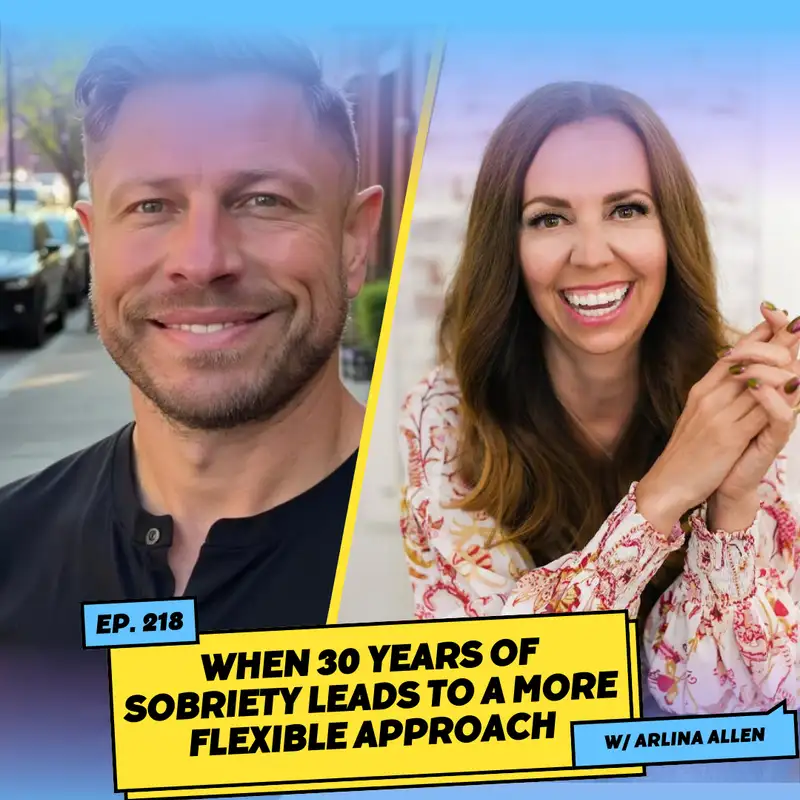
When 30 Years of Sobriety Leads to a More Flexible Approach w/ Arlina Allen
Today's episode is about flexibility. And more specifically, what happens when the one size fits all approach to alcohol stops working. My guest today is Arlena Allen. Arlena has been sober for over thirty years, and she spent decades working with high functioning professionals who want to change their relationship with alcohol without blowing up their lives. What makes this conversation different is that Arlena didn't start out open minded about flexibility.
Speaker 1:For most of her recovery, she believed abstinence was the only real answer, period. But over time, through her work with clients, her podcast, and her own willingness to question what she thought she knew, her perspective evolved. In this episode, we talk about what actually helped her quit drinking, what the 12 steps still get right even if you don't resonate with the whole program, and how to think about moderation, medication, and experimentation without shame or labels. If you've ever thought, I don't want to drink like this anymore, but I'm not ready to say I'm done forever, this episode is for you. Let's get into it.
Speaker 1:Arlena, thanks for coming on today.
Speaker 2:Thanks so much for having me.
Speaker 1:Let's jump right into it. So I want you to take me back to the moment that you knew that you had to quit drinking and what happened.
Speaker 2:Oh, dear. Yeah. Right for the jugular. Okay. So, I was about 23 years old, and I went out with my sister.
Speaker 2:And she was, like, the last person that was willing to hang out with me pretty much. But she and I went out, and I did what I had done many times, but to, like, a way worse degree. So I totally just got blottoed. I blacked out. And most of what I'm telling you is gonna be secondhand information because I totally blacked out.
Speaker 2:But it was, like, behaving badly at the bar, like, embarrassing myself. And, you know, it I'll have to tell you exactly what happened. So I had
Speaker 1:Tell us. Tell us.
Speaker 2:Oh my gosh. This is so bad. Like, I look back at that poor girl, and I'm like, what were you thinking? I had been dating this police. He was a DUI cop, so I never got a DUI because of this.
Speaker 2:I used to hand his business card with my driver's license when I got pulled over. Four times this happened. Four times. Yeah. And, anyway, we stopped seeing each other, but I was dating his best friend.
Speaker 2:That's what we do. But the guy that best friend was supposed to meet me at the bar, and he didn't show up. And I was really upset. And on the way home, we passed by the DUI cop giving somebody a field sobriety test, and my sister said that I lost my ever loving mind. She said I got really upset and started freaking out, and I punched the windshield with my little fit.
Speaker 2:I'm a little person, but I punched the windshield and broke it in a couple of place. She was driving my car.
Speaker 1:Yeah.
Speaker 2:And I nearly crashed the car, apparently got physical. I don't know even how this happened, but, it got physical between her and I. And she managed to pull the car over, and somebody called the police. And I didn't go to jail, but in the next morning, I woke up. My hand was all black and blue, and I just had that sickening sinking feeling.
Speaker 2:Something really bad had happened the night before, and I only had, like, bits and pieces. So I had to sorta tuck my tail and go to my sister's house and and ask. And she was living with my mom, so now my mom knew the whole thing. And she, like, told me this story, and I was like, what is the matter with me? Like, it wasn't the first time I had blacked out.
Speaker 2:It wasn't for the first time something bad had happened. I never got arrested or anything like that, but, I knew that there was something wrong with the way I was drinking because my friends weren't drinking like I was. And I was that's when I really started to question my drinking, and I tried moderation for two years. And I was finally like, I just can't do this anymore. And I actually knew a couple people that were in a 12 step program, and they sorta ushered me in.
Speaker 2:And and I've been sober for thirty almost thirty two years now.
Speaker 1:Wow. Amazing. So you had a very marked moment in your mind where this needs to change. You tried a few things, and then you have thirty years, which is incredible. And part of this conversation is now also you help other people in the same predicament, probably not the same story, maybe certain different circumstances, of course, but there's been an evolution in your thinking, and so I wanna get into that.
Speaker 1:So after many years in recovery, in working with people, and probably thinking through it for yourself, when did you start realizing maybe that the one size fits all approach wasn't serving every single person? And what were you seeing, I guess, with the people that you're working with that made that clear?
Speaker 2:So I started my podcast about ten years ago, and I was, interviewing people from all walks of life and from all different kinds of sobriety paths. And what was so interesting to me is I was sort of like in this little 12 step bubble, and I had a really good commute. I'm from Silicon Valley. I was a tech sales rep, and, you know, I I was just around all these people that were doing really well. So I was like, yeah.
Speaker 2:This is my bubble. And then when I started doing the podcast, I was introduced to all these different paths to sobriety. So I, for quite a while, had considered myself to be sort of recovery agnostic. Like, I don't care how you do it. Just you know?
Speaker 2:But I in my mind, I was abstinence.
Speaker 1:Yes.
Speaker 2:Like, it was all about abstinence, really. Once you start in my mind, I was thinking, you start realizing there's a problem, then you need to stop. Right? Like and and I really held that belief for a long time. And then I had an experience a couple years ago where I had this client.
Speaker 2:He's the CEO of a 10,000 person organization, highly functional, highly productive, struggling a little bit with overdrinking. And so I had heard about, medications that people could use. I've been starting you know, I'm in the sober sphere, so I was hearing about people using medication to moderate. And at first, I really dismissed it. I was like, that is prolonging the inevitable.
Speaker 2:I mean, all the things that you hear, I'm sure Sure. It's enabling. It's blah blah blah, all this sort of but I've watched this person over a year become very much, he was still high functioning. He was using it appropriately. He was having this experience of, wow.
Speaker 2:Using this medication before I go out, he's using it, like, if he had customer events or whatever, he would, take the medication before he went out, and he was able to, you know, moderate his drinking. And he was able to get up early the next morning and work out and stick to his morning routine and be very productive, and life is good. And I haven't seen any progression in his drinking. I have seen a decrease. And, you know, he has become more open to different ideas and practices that maybe he wouldn't wasn't ready to accept in the beginning, which I think was really interesting.
Speaker 2:So I was like, okay. We need to concede that there are people who can moderate. Yeah.
Speaker 1:Yeah. I mean, you hear about people that might have actually gone through what you did some variation of that and, like, literally the next day, never drink again. And that was, like, forty years ago. They never went to AA. They never did any kind of, like, behavior change.
Speaker 1:Then you hear about other people that go through the 12 step with success. People go through the 12 step without success. And then, of course, same with moderation. You know, moderation did work or didn't work, and then the 12 step did. And I'm with you.
Speaker 1:Like, every solution, as long as it works, is the right solution for that one person. But the hard thing is is that you're you have to be very careful about being in these echo chambers with everyone around you, and that happens a lot in 12 step. That happens here in moderation. And we have to remember that if we're constantly hearing our own ideas validated by somebody else who also agrees with us, we're sort of, like, stopping short, you know, from progressing and growing and having the best solutions for whoever needs them. You know?
Speaker 1:So I'm so glad to have this conversation with you today because it shows an evolution in your understanding over thirty years. And so in work I wanna ask you this question. In working with clients, a lot of people get stuck, and this really lends itself to this view of, you know, what do I do? You know, they say, I I don't wanna drink like this anymore, but maybe I'm not ready to say I'm done forever. What do you say to that?
Speaker 2:Yeah. Don't be done forever then. I mean, not it's funny because the name of my podcast is the one day at a time podcast. Right? So it's like, you really can't be sober tomorrow.
Speaker 2:Like, if you're gonna be sober, you can only do it today anyway. But I would say I would say you need to lean into that and gather your own data. And there's this idea that I learned in, you know, peer support programs about don't take my word for it. Take this information and do an experiment. Right?
Speaker 2:It's like do your own experiment, gather your own data, come to your own conclusions. And it is nice to be able there's a benefit to the echo chamber, but it could also be, like, confirmation bias. And what you were really talking about are critical thinking skills. Right? We want to be able to be like, if you ask somebody, are you open minded?
Speaker 2:Everyone's gonna wanna say yes. But that's not necessarily the truth. And what a barometer for really challenging your own thinking is if you're presented with an idea that's challenging and kinda pisses you off. It's like the truth will set you free, but first, it will piss you off. The idea is to sort of lean into that and to sort of that's that's a good place to start questioning your own thinking.
Speaker 1:I totally agree with, you know, where there's discomfort or you're uncomfortable, that's where growth lies. Sometimes, though, we always try to bite off more than we can chew, especially when it's, like, making these extremes. When something happens, it's like, that's it. I'm done forever. How do you tell somebody I'm gonna push into that question a little more.
Speaker 1:How do you tell somebody to maybe think about it more pragmatically in that, you know, is this really what you want, or is this what you want in this moment?
Speaker 2:Yeah. When someone is like, that's it. I'm never doing this. Like, that is an emotion based decision, and emotions are fleeting. Right?
Speaker 2:They they come and go. And and I prefer the methodology of a sort of tiny experiments. There's even a book called tiny experiment where you just get we're just talking about little baby steps. Because if you take on a lot of times people do this too. They go they're like, that's it.
Speaker 2:I'm not drinking. And I'm gonna eat right, and I'm gonna exercise five days a week, and I'm gonna read five self help book. And pretty soon, the whole it's not sustainable. It's not as sustainable. Like, we need to you don't go to the gym and pick up a 100 pound weight.
Speaker 2:I mean, I would you might. You you start off with a, like, a little baby weight. Right? And you work your way up. And so that you have this, unconscious incompetent.
Speaker 2:Like, you don't know what you don't know. So you you try a little bit, and then you become, competent. Right? So it's kinda like you you try something new, you suck at first, and then you get a little bit better. Pretty soon, you're pretty good.
Speaker 2:Right? So it becomes an unconscious competence, like like driving. Right? You're terrible at it at first, and then now you can drive home. You don't even know how you got there.
Speaker 2:So adding little things, like little teeny baby steps first, like starting a five minute meditation practice. Or I use a five minute journal. It takes me way longer than five minutes to fill it out. But do you know what I'm saying? It's like and then you start building consistency, momentum, you get better, and then you can start layering on other other modalities.
Speaker 1:Well, a 100%. I it it stupid story, but it reminds me of the other day. So I hurt my back. I went I so I kinda took a break on doing some certain exercises in the gym, and I went back after probably, like, four weeks to doing legs for the first time, and I overdid it. You know, I went way too in, and it was so painful for, like, a week that I never wanted to do legs again.
Speaker 1:So, you know, it sort of reminds you that. Like, I should have eased into it. I should have done less weight, less movements, and it wouldn't have been so painful for me to wanna do it again. I think habits can kinda align in that way.
Speaker 2:Absolutely. Absolutely. And then I get the temptation when it comes to drinking, especially if you've had, like, a bad experience to just be like, I can never do this again. And that can be really powerful for some people, but that can also like, if you're coming at it from, like, the that's it. Never again.
Speaker 2:I'm changing everything. Like, that's not the way to go. There's you know, being gentle with yourself and allowing your your whole psyche to sort of adapt, like, these changes slowly is really what lie leads to consistency and longevity.
Speaker 1:I think anyone listening to this podcast has probably told that to themselves. Like, that's it. Today's the day. You know, in some form or another, I don't care where it is or what your level of, you know, discomfort is. I think everyone here has probably said that.
Speaker 1:Now you said one thing there around one day at a time, the name of your podcast, and and as a strategy or or principle, and I a 100% agree. You know, coming out of the 12 step program, one of the principles of taking it one day at a time or chunking things down instead of looking at this mountain that you have to climb, I think, absolutely works. And there's studies behind that it works. But let me ask you this. So the 12 step helps a lot of people, but it also can feel very rigid.
Speaker 1:It can feel intimidating. It's associated to identity. And you kinda look at each part on its own. So are there useful parts that even people who don't connect maybe with the whole program that you really like?
Speaker 2:Absolutely. I I wanna just clarify one thing. Meetings and the steps are two separate things. Right? And I really focus on the steps.
Speaker 2:And if I was gonna pick out one thing, one step that really was the game changer for me, like, at a really profound level that really, like like, I've also been married. I've been with my husband for nearly the whole time. I know you're now it's supposed to get in a relationship your first years five months over. I've been so far so good. Thirty three years later, so far so good.
Speaker 2:It it this one process is actually the fourth step. It's a searching and fearless moral inventory of ourselves. So it's really a self reflection exercise, but it's also like a denial buster. Like, it's like a denial ninja. Like, it's so interesting to it's a process to break down your thinking.
Speaker 2:And I thought about this question ahead of time thinking, you know, we all go through life of and you kinda gather baggage. Like, you have negative emotional experiences. You don't really know how to process. Maybe you suppress things. But, you know, by the time you're our age, well, you're a lot younger than I'm.
Speaker 2:But do you know what mean? It's like once you reach an adulthood, like, you're carrying some baggage, and this is a way to sorta unpack your baggage and get really specific. It it it starts off with resentments and angers, think things that you're angry about. You know, who are you angry at? What is the specific cause?
Speaker 2:How did it affect you? Whether it's your self esteem, personal relationships, finances, emotional security. How were you affected specifically? And then what was your part in it? What role did you play?
Speaker 2:There's this idea that in every relationship, there's a fifty fifty shared responsibility. And when I went through that process of the writing exercise, first of all, it was licensed to bitch. I didn't realize that at first. It's like, what? My I get to write down all the reasons why I'm the victim?
Speaker 2:Somebody has to listen to all this? It's amazing. But, really, what ended up happening is I began to see patterns in my behavior and that I played a how I played a role. And and then when I shared it with somebody, it was like, oh, they were able to insert different options I hadn't even considered. So I was a it was a sorting process where I was able to let go of things that weren't mine in order to bear the weight of what was.
Speaker 2:Because at the end of the day, it's about personal responsibility and accountability. It's really an empowerment exercise. It's it break it broke my denial where I was able to see my patterns clearly. And I've used that in relationships, at work, in every I've applied it. I've used it to, you know, maintain my emotional emotional sobriety, like, stay grounded and even tempered.
Speaker 1:So you have this idea that you've developed around take what you like and leave the rest. Talk about that because it sounds like you've done that with 12 step. It sounds like you've applied it to other places. Maybe you might wanna share what you decided to take and what you decided to leave so that somebody kinda gets an idea on how they can build their own approach.
Speaker 2:Yeah. Well, listen. I appreciate you crediting it to me developing. No. I totally this is a 12 step idea.
Speaker 2:Actually, it's in the literature.
Speaker 1:Okay.
Speaker 2:You yeah. It's in the actual literature. They're like, hey. I don't then this was, like, this is what I really liked about it. You know?
Speaker 2:And this is how I feel too after thirty one years. I don't know what's right for anybody else. That's all I know for sure. And I
Speaker 1:think with that you. Right? We like to pretend, but it's a best guess. And we're all so unique that you're constantly it's unsurprising surprising about how different other people are, but you're always surprised anyways.
Speaker 2:I know. It's so funny. It's it's like what I've learned too, though, is, like, the circumstances are different, but the feelings are all the same. Like, at the at the root, we're kinda all the same, but the circumstances are all different. And, like, one another idea from 12 step is to look for the similarities, not the differences.
Speaker 2:And when I think about similarities, I think about the feelings. Like, you know what it feels like be sad and frustrated with yourself. You you know what it feels like to have self doubt to you know, I'm never gonna do this again. It's like there are some pretty common feelings even though the circumstances are different. But the idea of take what you like, leave the rest showed up for me.
Speaker 2:Like, I liked going to meetings. Like, I I liked hearing people's stories. I liked hearing how other people, dealt with their own challenges around social situations, how to manage their emotions, how to find peace. It was all about learning how to live in a healthy way. But there are some people who are sharing stuff where I was like, you're batshit crazy.
Speaker 2:Do you know what I mean? And I'm like
Speaker 1:I I do know what you mean because I've been to meetings before. So, yeah, I think
Speaker 2:It's not the habit of mental health. However, one perspective is to look at this like it's an opportunity to practice things like setting boundaries, speaking your truth without blame or judgment, allowing people to have an opinion without needing to insert my own and make somebody wrong. Do you know what I mean? It's like a practice a place to practice showing up and being of service, but, like, people have opinions. I don't I don't need to even if they've been sober a long time, I don't I don't need to take what they say at face value.
Speaker 2:So and there were and there were some other I mean, people have all kind like, there are religious people that go there. I am not religious at all. And so peep people would share how they get sober, and they talk about their religion. And I'm like, good for you.
Speaker 1:Yeah. Yeah. Yeah.
Speaker 2:It's not a thing.
Speaker 1:I actually was curious about that. Like so for me, I think a lot of people listening are also rebellious in a way, like, just the personality kinda. But, like, even when you brought up things like, I know you're not supposed to be in a relationship, and I'm like, sis who? You know, in my in my mind. You know?
Speaker 1:Even if it did right
Speaker 2:somewhere I was in a relationship.
Speaker 1:Or or, you know, or tell me I'm supposed to believe this way, sis who? Is that is that how you kind of approach it with that take what you like and leave the rest just, you know, to each his own good for you? Is that sort of the outlook you come with?
Speaker 2:Yeah. And I you know, as an original idea, in the literate in the literature, it says rebellion dogs are every step. Rebellion dog I am in a room full of people who are super rebellious. Right? And so I felt like a lot of the take what you like, leave the rest ideas sort of deescalated that defensiveness, so to speak.
Speaker 2:Like you know? And a lot of people are like, hey. This is what worked for me. Yeah. You know?
Speaker 2:Those are the people that I gravitated towards and still do. I still gravitate towards people who are like, this is what I did. You know, give it a shot. See how it works for you. You know?
Speaker 2:If not, cool. Like, nobody cares.
Speaker 1:Yeah. Now a quick pause to share something important. Did you know there's a daily pill that can help you to drink less without having to quit entirely? It's called Naltrexone. It's been FDA approved since 1994, and it works by disrupting the reward cycles that fuels cravings and binge drinking.
Speaker 1:At Sunnyside, we now offer access to compounded naltrexone through Sunnyside Med, a personalized, doctor prescribed medication that's delivered discreetly to your door. And because it pairs with Sunnyside's proven habit change system, it helps you build real, lasting change. Over 500,000 people have used Sunnyside to cup more than 24,000,000 drinks. And for many, this new option has been a game changer. Head over to sunnyside.co to learn more and see if you qualify.
Speaker 1:So we talked a little bit about, like, the approach, but, like, let's go back a bit to the starting point and that a lot of people are still trying to figure out what do I actually want. I know that took me a long time. You know? So when you're working with people now, how do you help them figure out what kind of support they need, whether it's moderation, whether it's sobriety, maybe it's something else, without maybe pushing them into this high pressure stakes feeling like that they gotta identify define their identity right away around this.
Speaker 2:Yeah. It's interesting. So I, you know, I come from Silicon Valley. I did tech sales for ten years. And one of the things that they teach you in sales that is if you push somebody, it creates resistance.
Speaker 2:And, I had somebody do this exercise with me. He was like, hold up your hand, and I held up my hand. And then he put his hand on my hand and pushed a little bit, and I just pushed back. And he's like, why'd you push? I'm like, I don't know.
Speaker 2:He said, it's human nature that when we are pushed, we typically push back. And so when someone comes to me and they say, you know, everybody knows that I you know, I'm in this mental health space, let's say, and behavior change, addiction, recovery is kind of my area of expertise. But I I you have to meet people where they're at because people are in a position because their thoughts, actions, and beliefs make sense to them. And it could be like this cognitive dissonance where something's not working in my life, and I can't quite close the gap. And so my whole thing is is like, well, what is it that you like, what you said?
Speaker 2:Like, what is your goal here? And I have people that are like, I need to answer the question. Can I moderate? Which I think is a crucial question to answer. Because if you have any doubt whatsoever, it's gonna be very difficult to practice abstinence if that's where you're headed.
Speaker 2:Mhmm. Right? So you have to shoot every angle. Use all your brainpower, willpower, discipline to try to moderate. Most people wanna try to moderate.
Speaker 2:Do it. Try. But let's be a little bit scientific about it. Right? Like, run the experiment.
Speaker 2:Gather some data. What did you get out of it? What did we learn? Not gonna Yeah. What did we learn?
Speaker 2:What did you learn from that? Did you like it? I I was one of those people that I didn't get have a bad experience every time I drank, but every time I had a bad experience, I had been drinking. And for me, that was kinda like, alright. You you know?
Speaker 2:I listen. I I learned pretty early. I crashed and burned early. I knew I had to practice abstinence, but I did try for two years to moderate. And I gotta tell you, it was so much easier for me to practice abstinence, but I do know people who can successfully moderate.
Speaker 2:So, you know, it's this idea of being open, meeting people where they're at, and just supporting someone as they run their experiments.
Speaker 1:I love that, and I totally agree. And for some people, yeah, moderation can be easier. For some people, abstinence or sobriety can be easy easier, and sometimes you gotta try both to figure out which one fits for you. I know for me, I had to let I had to list out, like, what are the benefits here? And I'd list list them out.
Speaker 1:And what are all the benefits of doing this way? And a lot of the times, like, the benefits or the things that I think I'm missing, like, feel more comfortable at a party, relax after work, they were pretty insignificant in comparison to the benefits, right, that I'm seeking. And then and then once I look at that list, you know, I looked at, okay. Here are the paths that I can take. Which ones support best what I really want to achieve?
Speaker 2:And that's a very positive approach. I needed both the carrot and the stick. Like, there's kinda two forms of motivation. There's the carrot and the stick, and it's so powerful to use the carrot because that is so future pacing. It's like, what do I want out of my life?
Speaker 2:How do I wanna spend my time? Who are the people? What experiences do I wanna have? I love that. It's super powerful.
Speaker 2:And why not use leverage of the negative experiences that you already have? Like, we don't need to create new ones. Most of us have plenty of negative experience that we can draw from and use both the care and the stick to help us, you know, be on whatever path that we wanna be on. If it's moderation and using something like naltrexone or whatever, that's what I see some people doing. It that trigger is for them to use their medication before they go out.
Speaker 2:Right? Or however people use that. I think some people use it daily or whatever. But do you know what I mean? It's like, why not use all the motivating factors at our disposal?
Speaker 1:Oh, I totally agree here as well. And, you know, that can be a difficult one where it's like all the things that might cause you problems now and all the things that might potentially cause you problems in the future. Have you ever done, like, the, like, the time machine exercise? There's a couple different ways of doing that where you basically this one has been impactful for me, and and you basically imagine yourself two versions of yourself. The one that you're currently on the path that you wanna change but you do nothing or the one that that follows what what you envision for yourself, and you move yourself five years.
Speaker 1:Like, how does your career look? How do your relationship look? Then you move it ten years. Then you move it twenty years. And you do it for both those versions.
Speaker 1:And the one that is an unchanged path, it can be a pretty uncomfortable thing. You know, health is impacted, having hard conversations at the doctor. Maybe you never really advanced in your career or worse, like, every single part of your life. And, yeah, that one is really impactful. I almost do them in tandem, in in regard to the benefit one as well.
Speaker 2:Brilliant. I love that. I think I did something similar at Dickens process. I did, like, a Tony Robbins Uh-huh. Yeah.
Speaker 2:Or whatever. They they actually, you know, facilitated that experience, and it was really powerful. Yeah.
Speaker 1:Just I I definitely borrowed it from somebody, but I I adapted it a little bit to, you know, what we're talking about here.
Speaker 2:You're you're pragmatic. It's simple. Not easy, but simple. And then I find those simple exercises to be really powerful because it's not comfortable to think about if I do nothing five years, ten years, you can I mean, look at at my age, you know, I look at my peers who are I'm 57? So at my age, you know, my peers are experiencing health issues, divorce, alimony, problems with kid.
Speaker 2:I mean, listen. I look at my peers, and I'm like, I am so grateful I quit drinking young.
Speaker 1:57. You look fantastic because you surprised me. When you said I'm a lot older than you are, it's like, I don't think you are. I'm I'm 47. I just turned 47 in January.
Speaker 1:But you you got some years on me, but you would never know know it. Excuse me.
Speaker 2:Noticed it. Hard on the face. K.
Speaker 1:Shoot.
Speaker 2:Alcohol is hard on the face.
Speaker 1:Yeah. You're doing something right. So good for you. No. So you mentioned naltrexone.
Speaker 1:Let's get into that because let's talk about some tools. So you've worked with clients who combine behavior work with things like naltrexone. How do you think about medication in this context? Because you had an initial knee jerk response to it. But over time, how are you looking at it today?
Speaker 2:Yeah. It's so funny because I I really wanna be an open minded person, and I didn't realize how, like, narrow minded I had been. And I actually but I that's maybe not super fair, because I had been aware I had been interviewing people who had used things like Vivitrol and naltrexone. I I don't know if there's other things out there. I'm not super like, I'm not a doctor.
Speaker 2:I don't play one on the Internet. And so I was I just hearing stories about what's working for people. And I am hearing such good things. People I have three clients that are using medication, to moderate, and one is using it as a bridge to abstinence. One and I think the other two one, don't think we'll ever quit junketing or using, and one is on the fence, I would say.
Speaker 2:There's sort of they're all in three camps. And Yeah. So but that is just one of the tools. Right? I typically start people off with a a morning routine because what what you how you, like, how you prime yourself in the morning kinda sets the stage with intentions.
Speaker 1:Oh, 100%. 100%. So important and impactful and easy.
Speaker 2:And easy. Thing about the morning routine, it's it can be very deceiving because it's easy.
Speaker 1:Yes.
Speaker 2:It can be very easy.
Speaker 1:Couldn't be that simple. It might not be always easy, but it couldn't be that simple, I guess.
Speaker 2:Yeah. People are like, I need to suffer for this. Right? No. Absolutely not.
Speaker 2:And I think that's you know, we tend to value what we suffer for. And so things like meditation and journaling are very easily dismissed, and this is what happens for most people. You wake up in the morning, and you're sort of at the crossroads. Either you can check your email, check your social media. You you you sort of like you had or you could sequester yourself for thirty minutes, let's say, and do your self care.
Speaker 2:And sometimes people are like, I'm just gonna check my email for one second. Like, we lie to ourselves. We're like, I we say, I can check my email for five minutes. And then my CEO client does this all the time. I'm always on him about it.
Speaker 2:Before because I'm like, before you check your email, do your five minute journal, you know, meditate for five minutes, whatever. And then because otherwise, you you check your email, you might some there's always a crisis.
Speaker 1:You're off to the races.
Speaker 2:You're just off to the and then you can't you can't settle back into you can't check your email and do all this and then come back and settle into a meditation practice because your mind is like, I need to solve some problems. So, the challenge is when you are standing at the crossroads is to and I love James Clear because he's like, make it obvious, make it easy, make it attractive, make it satisfying. Those are the four laws of behavior change according to James Clear. And so
Speaker 1:Make it easy. Make it tell say
Speaker 2:that again. Obvious, attractive, easy, and satisfying. Got it. And if you wanna break a habit, you do the inverse.
Speaker 1:Do the inverse. Yeah.
Speaker 2:So instead of making obvious, like
Speaker 1:Make your new habit hard or the habit you wanna break harder to do. Yeah. Less obvious on how to do it, etcetera.
Speaker 2:Yeah. Like, he used the example of drinking beer, which is kinda funny. He's like, if he puts he if he puts the beer in the front of the door or whatever, whenever he like, who doesn't open the refrigerator five times? Yeah. I don't know.
Speaker 2:He he'll see it. He'll go, oh, I'll have a beer. He moved it to the back of the refrigerator. So he opens the door. He doesn't really see it.
Speaker 2:He doesn't drink. It was just like a so it's not obvious. So he if you kinda actually has a workbook that just came out that I'm obsessed with, and he's doing all these interviews. But it's so interesting about habit change. He he talks about the habit of starting some like mastering the art of starting is really that's the initial hurdle, which makes sense because once you master the art of starting, then you have momentum on your side.
Speaker 2:So I think those are really interesting ideas about starting a habit and breaking them. It's really powerful.
Speaker 1:Oh, I never even so I'm taking a year off right now, but when I was, like, you know, occasional, I just never kept in the house because I just Right. First, I liked going to the store and picking something out, so it was part of, you know, something I enjoyed. But, like, yeah, just, like, keeping a reserve. Some people, I see them at Costco buying these giant bottles, and I'm like, I just could never have something like that sitting on my counter
Speaker 2:Alright.
Speaker 1:Every single day. You know? Like, I don't know.
Speaker 2:Yeah. I'm guilty. I like to bake. And so, like, this weekend, I had some bananas that were turning brown. So, of course, I had to make banana breads.
Speaker 2:And now I got a bunch of muffins sitting on my counter, and I'm like, oh, I need to put these somewhere else where they're just not on the counter because it's so easy to get my coffee and grab a muffin before I use
Speaker 1:Oh, yeah. No. I I say that for the alcohol, but it'll be anything. Like, if you got you got snacks or sweets sitting around with an eye shot. Oh, yeah.
Speaker 1:Just a little bit here, a little bit there, and all of a sudden you got a sweet tooth that developed. It's, like, out of control.
Speaker 2:Forget about it. Yeah. Brutal.
Speaker 1:Okay. That's where we'll stop for today. In part two of this conversation, we shift gears and talk about why self care and habit change are so hard, even when you know exactly what would help and what's really going on underneath that resistance. If you've ever felt stuck, inconsistent, or frustrated with yourself, you'll want to listen to the next episode. Thanks for being here.
Speaker 1:I'll see you in part two.
Creators and Guests