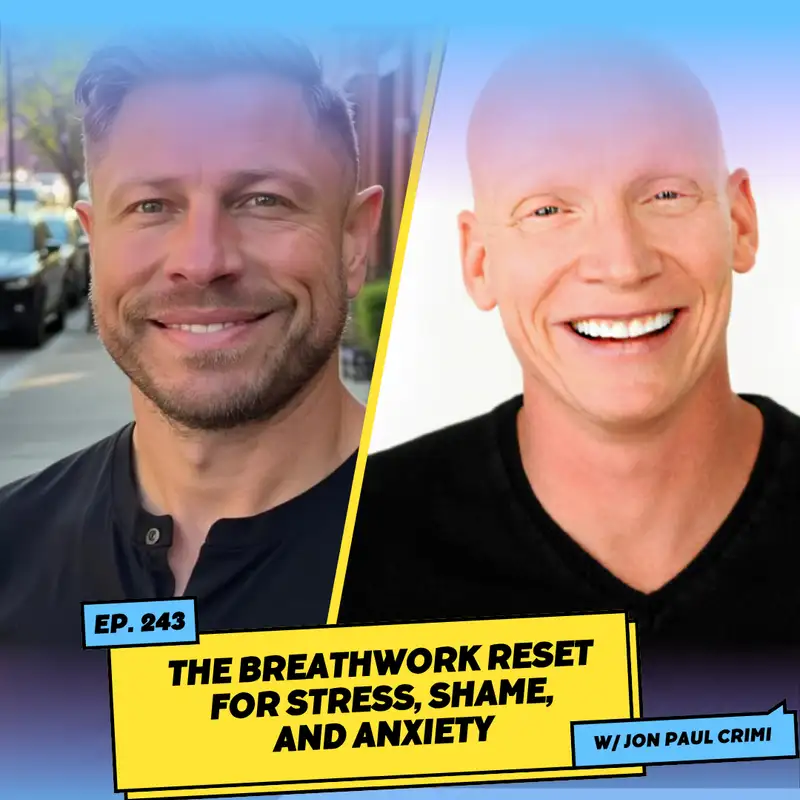
The Breathwork Reset for Stress, Shame, and Anxiety w/ Jon Paul Crimi
John Paul Crimi is a former celebrity trainer and sober coach turned Breathwork teacher who has worked with CEOs, Olympians, and some of the most recognizable names in entertainment. In this episode, John Paul shares how breathwork helped him move through addiction, anger, identity loss, and shame, and why he now teaches it as a practical tool for emotional detox. We talk about the feelings we push down, why habits like drinking can become ways to escape what we haven't processed, along with how a circular breathwork can help release stress, anxiety, shame, and emotional buildup. Okay. John Paul, thanks for coming on today.
Speaker 2:Thanks for having me, Mike. I'm excited to be here.
Speaker 1:So am so am I, especially since somebody who does Breathwork continues to have a lot of things that I need to still learn. So I'm looking forward to this conversation. But before we get into all of that, for people who don't know you yet, can you give us, a little bit of your story?
Speaker 2:Sure. I'm from, the South Shore Of Boston, Massachusetts. Right? And it's the fifth most Irish town in America. It's Pembroke.
Speaker 2:Surrounded by the 13 most Irish towns in America. They call it the Irish Riviera. So, I didn't know that growing up. I had I had just thought everybody had, you know, red hair and beat the shit out of each other and got drunk and, you know, got in fights and had 17 brothers and sisters. And, you know, with a name like Jean Paul on in South Boston, it was like people like, Jean Paul, are you French?
Speaker 2:Are you, you know, are you French? And I'm not French. I'm actually Irish, Italian, and Scottish, which means I like to drink a lot. I don't wanna pay for it, and then I wanna start a fight. So and then, you know, being from Boston, that means the same things as well.
Speaker 2:So it was it was a pretty wild childhood. I didn't realize that it was crazy. You know, it was a normal middle class suburban neighborhood. But what hap a lot of people had moved there from South Boston into this neighborhood, and so it was like the city in a suburb. Like, people would steal your bike.
Speaker 2:People parents would be getting drunk fighting with each other. It was wild. And you don't know that because that like, any different because that's how I just grew up. That's how I thought everything was. Sure.
Speaker 2:Sure. So I just I felt a little different. I felt a little out of place. Everyone was into sports, and I was into, you know, music and, you know, movies and things like that. So I moved out to LA when I was 23 to become an actor and studied acting.
Speaker 2:I studied method acting, and that's when I got alopecia, which is hair loss. I started losing my hair. So it was started in patches, and they were giving me, I was taking prednisone, which is a catabolic steroid. Bodybuilders take anabolic to get huge. Catabolic breaks down muscle tissue.
Speaker 2:So I was taking fat steroids, essentially, I like to say, while I was working at Gold's Gym in Venice, the mecca of bodybuilding. So I'm everyone's taking everyone around me is taking anabolic steroids, and I'm taking catabolic steroids. And, and I was getting cortisone shots in my eyebrows and in my head to try and keep the eyebrows and try and keep my hair, and it was really painful. I'd get, like, a hundred, two hundred shots in a visit. Wow.
Speaker 2:And I started eating Vicodin before I go get the shots, and then I just started eating the Vicodin all the time. Because Vicodin is not just a pain blocker. It's an emotional pain blocker. And I couldn't deal with what was happening to me at the time. Like, my self esteem, sadly, and my self worth were wrapped up in my looks.
Speaker 2:I was a fitness model. I was trying to become an actor. And and if your self worth and your self esteem is wrapped up in your looks or your career or your marriage or whatever and that's stripped away, then what do you have? And so I was going through a real identity crisis and a real hard time, and I it just ramped up my drinking. So I was taking, like, thirty, forty, fifty Vicodin a day sometimes and then drinking at night until I passed out.
Speaker 2:And I went to a therapist, and she had suggested, you know, maybe looking into twelve step recovery. And I was like, what do you mean? I'm like, you know, I I'm successful. I've got the scholarship. I'm doing all these things.
Speaker 2:You know? And I just kind of brushed it off. But eventually, it was undeniable. I went on a really big bender and, you know, almost got arrested one more time. And that was the cut the catalyst for me to to get sober and change turn my life around, you know, to to really start to work on myself.
Speaker 2:And I decided to get off all the medication, to get off the prednisone, to get off the cortisone shots, and I lost all my hair. And the doctor said, you gotta lose all your hair. I was like, I can't live like this because the prednisone was giving me an ulcer and to keep my hair. You know? It was just killing me.
Speaker 2:Yeah. So I went through some massive changes in that first year of sobriety. I don't look the same. You know? I I I really started to dig in and do some work on myself and just start to really do the work and see what that looked like.
Speaker 2:So that's that's kind of a a brief synopsis of a
Speaker 1:Yeah.
Speaker 2:Of a much longer story.
Speaker 1:Well, no. I mean, I can only imagine that when your identity is attached to things and so many of us attach our identity to our outward appearance. So when that's going whether it's hair loss or whatever it is, weight gain, it doesn't matter. It's a difficult time. So somewhere in that time, I mean, it's understandable that you went through all these hardships.
Speaker 1:And, you know, if we were to fast forward to now to where you are, somewhere in that journey, you found Breathwork. What happened? How did that happen? What happened in that first Breathwork or in that period where you just said, this is it?
Speaker 2:Yeah. Well, we should probably tell the story of how I found Breathwork. So Matthew Perry, the actor from Friends, was a really dear friend of mine. And so he we were hanging out a lot, and we were going to the Kings games, the Los Angeles Kings games, and we were following him around the whole season. It was incredible.
Speaker 2:And that happened to be the season they won the Stanley Cup. So we're in, like, game six in the Staples Center, and we're in this little VIP room and, you know, Will Ferrell and Vince Vaughn, and everyone's in there, Zach Efron, and in walks Tony Robbins. Crazy. I go, holy shit. It's Tony Robbins.
Speaker 2:And Matthew goes, really? We've been following the Kings all season, and every celebrity in LA is in here right now. And you're excited about a gigantic man? And I was like, no. Tony's amazing.
Speaker 2:He, I had his book in high school. I had his tapes. You know? That's how old I am. And he goes, really?
Speaker 2:Well, go tell him. You know? You're a fan. I go, no. I don't wanna be a pain in the ass to him like everybody is to you.
Speaker 2:But I was walking through the tunnel, and Tony looked up from his phone. He goes, hey, man. How's it going? And I go, shit. Yeah.
Speaker 2:I go, I I know I I I never do this. I know everybody says that, but I'm a huge fan. I've been following you since high school. He goes, have you ever been to my seminar? And I go, no.
Speaker 2:He goes, well, I only do three domestically a year now, but if you wanna come next next month in San Jose as my VIP guest, I'd love it. And so he he comped me as his VIP guest as to his seminar, and it was life was life changing. I had, like, an epiphany in there where was like, I'm done with all the Hollywood stuff. Like, because I was trying to be a screenwriter, and I got really close to selling some screenplays, and I was in development with Imagine, which is Ron Howard and Brian Graser's company, and I was in development with the guys who did transformers and at Paramount. And it just was so frustrating.
Speaker 2:And I just said, you know what? I'm done with this Hollywood stuff. I'm just gonna help people. Whatever that looks like. Like, my my life will have been worthwhile at the end if I just help people.
Speaker 2:I'm really good at helping people. I was a sober companion at the time, like helping a lot of people in sobriety. So I worked with a bunch of rock stars touring with them on the road and, actors helping them get sober. So I said, I'm just gonna help people. I don't know what that looks like yet.
Speaker 2:Maybe it's sober companion work. Maybe it's something else. And then when I got back, Matthew, you know, he could see a big shift in me, and some girl had taken him to a guru guy in LA, and he was telling me about it. And I go, dude, that sounds like nonsense. That sounds like horseshit.
Speaker 2:He was asphyxiating you or whatever. He was telling me how weird all this stuff was. He goes, well, I bought you a session with the guy because I want you to experience this. Right? Because you're my only friend that'll do it and that's open minded enough.
Speaker 2:I go, alright. I'll fucking do it. Whatever. So we I went and did it, and it was weird. It was new age y and woo woo.
Speaker 2:And we did this breathing technique, which is not the technique I teach today. It's a very unusual technique that I don't see taught out there. And it's kind of I consider it a little bit unsafe in some ways because you can pass out and hit your head, and people have done that. So anyways, he did this breathing technique, it was really intense. And I had kind of an awakening.
Speaker 2:I had an experience. And the next day, my brain was, like, completely turned off. I had never experienced this before. It's similar to what Eckhart Tolle talks about in the power of now where he's sitting in the park bench, and he's just completely present, and there's nothing. There's no he's not thinking about anything in the future.
Speaker 2:He's not thinking about the past. He's 100% present and, like, it was like enlightenment, it felt like. And I felt like that the whole day. It was incredible. And so I started going down a rabbit hole of breath work and doing all these different kinds of breath work.
Speaker 2:And I'm, you know, I'm this guy from South Boston. I'm not like I'm going to these classes that were so new age y, so woo. And I'm like, oh, what is this hell that I have walked into? Right? Like, what is this weird shit?
Speaker 2:You know, the teacher's, you know, on a freaking sheepskin rug and there's crystals and there's oils, and I'm going, oh god. This is awful. But the experiences I was having were undeniable. Right? Like, was having these massive experiences.
Speaker 2:That first breath work I went to where I laid down and breathed, circular breathing, which we'll talk about, I had an experience that I'd never had before. I cried in a way that I'd never cried before. It was like years of shit, years of trauma, and things that had happened to me came out of me in that session. People say after my classes, holy shit. That felt like twenty years of therapy without saying a word.
Speaker 2:That's what it felt like. So I had that experience. I didn't love the classes. I didn't love the teachers and the style and the music or any of that stuff. And I started doing it every day.
Speaker 2:Every day I would do breath work on my own. And sometimes I would go to a class and I'm like, oh my god, the teachers and the music's terrible. But I made my own playlist and I started doing it, and my clients and my friends and people were like, dude, you're a different guy. You're like present and happy. What's going on?
Speaker 2:And I was twelve years sober at the time, and I said, I'm doing this weird breathing thing. And they're like, what what what breathing thing? What is it? And I I said, you know, you lay on the floor and you breathe in this way, and they go, show me. So I started taking clients and friends through Breathwork sessions, and they were having these massive experiences.
Speaker 2:And I would hear people share about being depressed or being angry, and I go, here. Come try this thing with me. So I I started learning under these two different guru guys all this stuff, and they were amazing teachers, but they it just was a different style than than who I am. And I had an epiphany, which was, why doesn't everybody know about this? Well, everybody should know about this Breathwork.
Speaker 2:There's five people in these fucking classes. There should be 5,000 people in these classes. And I realized, I thought it it's because it's been kept in these new age kind of woo woo circles. Like, if I somebody did it like Tony Robbins, if somebody did it East Coast, edgy, funny, and also put the science in there and played cool music, there'd be hundreds of people in these classes, maybe thousands of people. And I was right.
Speaker 2:I, you know, I regularly have anywhere from a 100 to 300 people in my classes. I taught the biggest class ever in Switzerland with 900 people last year. And then ironically, Tony Robbins people reached out to me last year and said, heard, you know, great things about you. We'd love to see if you wanna come to a Breathwork class. Amazing.
Speaker 2:In Tony's life mastery. Yeah. It was a full circle moment. I was like, do you know my Tony story? And they're like, no.
Speaker 2:So I got to share my Tony story, and it was like a great full circle moment.
Speaker 1:What a what a beautiful story. And I can comment from my own experience about how impactful breath can be. And, you know, you talk about, like, the woo woo and why don't more people do this? I'd almost think part of it also is just breath. It couldn't be that easy.
Speaker 1:Right? Yeah.
Speaker 2:Yes. That's the thing. There's something I've been doing since I was born unconsciously my whole life. How is it gonna feel like twenty years of therapy? I've been breathing every day.
Speaker 2:You're gonna show me a way to breathe, and it's gonna it's gonna clear out my stress, my anxiety, my generational trauma. They can't wrap their brain around it. They can't understand how that's possible until you come do it. And I do my best to prepare people properly, and they're still not prepared for what's about to happen.
Speaker 1:Yeah. So I can make a comparison. So for example, you know, over the past, like, eight years, I've done a lot of work with psychedelics in a therapeutic sense only, and I can say that and that's all the rage right now. Everybody's talking about it. It's a very easy solution because you if you can find a reputable facilitator and have that experience, it it's impactful.
Speaker 1:It's life changing. But as I've also found in my own Breathwork that it can be equally impactful in in in crossover ways and in different ways. And so if anybody's listening, I gotta tell you from somebody that's done a lot of different kind of work with other medicines that this is the real deal, that it you can have full emotional, spiritual releases, and and it can almost come out of nowhere at times.
Speaker 2:Yeah. It's it's probably the best comparison out there is psychedelics and, all that kind of stuff. And people will ask me all the time because a lot of people come to me from these psychedelic journeys, you know, because they do breath work at some of them, and they'll they're expecting a big shift from the psychedelics, but what they're not expecting is how impactful the breath work is. So then they come to my trainings and different things. I say the biggest difference is psychedelics, you kind of have to plan it all out and do all that all the stuff that goes with it.
Speaker 2:Whereas breath work, like, I can lay down on a Tuesday afternoon and do a breath work session and then go pick up my kids from school. Exactly. You know? I can have a fight with my wife and then come up here and breathe for twenty minutes and then come back downstairs and be like, I'm sorry. I was a jerk.
Speaker 2:It was so stupid. You know? Like Yeah. I have a jerk that says I'm sorry for what I said before breath work. And and it really it really sums it up.
Speaker 2:It's true. What it it it it gets me to the center of what's really important in my life. You know, I'm worried about this. I'm I wanna be right about that. All this shit's bothering me.
Speaker 2:My kids are, you know, I'm worried about my kids' futures with AI. All this shit. And then I lay down and breathe, and then I get to the center of, like, this is what really matters right now in my life. Just be present and loving and kind to the people around me. That's it.
Speaker 2:Right? Like, all the other shit is just shit that may happen or may not happen. But let me get really present and love the people around me right now.
Speaker 1:Yes. Yes. I love that. And one thing that I've witnessed being in certain communities that that a lot of people have worked with sacred medicines are now moving more exclusively to breath work just because it's almost like a graduation from one modality to the other and not they're both very impactful. So anybody that's listening that has preconceived notions that breath work couldn't be that impactful, You know, there's a lot of signals that are showing that it you should at least give it a try.
Speaker 1:And Yeah. So I wanna ask you this because I'll ramble this list off. You know, you've worked with everyone from CEOs to Olympians to Oscar, Emmy, and Grammy winners. What are people usually coming to you for Breathwork for?
Speaker 2:Well, I mean, if they're an Oscar winner or a Grammy winner, they thought the Grammy was gonna fix them. They thought the Oscar was gonna do it. Like, they worked their whole life. And, like, when I get this Olympic medal, when I get this Oscar, then I will be happy and whole. Right?
Speaker 2:And you cannot it's not gonna the Oscar's not gonna fix that hole inside of you. And they get there, and they often start drinking or using drugs or whatever, or they're just like totally disillusioned like that didn't fix me. Because you can't fix yourself from the outside in. There's no thing that you're going to get on the outside that's going to fix this ins it's an inside job. So those type of people, you know, it's it's that inside work that needs to be done.
Speaker 2:They have all the money. They have the career. I mean, that's the that's the mind fuck is is when you think you think, okay. If I get the if I get the the job, the career, the wife, the house, and you get all those things and then you're still fucked up inside, now what? Right?
Speaker 2:Like, you checked every box. And, and then there's the people who are just a housewife struggling with depression or, you know, is stressed out or something like that or guys who are I get a lot of guys who are they're high achievers, but they're not dealing with their emotions. Right? They're so focused on achievement and getting those goals that when something happens, they just push it down. They don't deal with it.
Speaker 2:You know, the feeling requires to be felt, And things are going to happen in our lives. People are going to die, you're going to have grief, and if you don't deal with it, grief gets stuck in the lungs. And so these things, these feelings require to be processed. You have to process these feelings at some point. Everybody wants to feel the good stuff.
Speaker 2:They wanna open themselves up to gratitude and love and joy, but they wanna shut themselves off from, you know, grief and pain and disappointment. And it doesn't work that way. You can't open your heart to gratitude and love and joy and shut yourself off from the other stuff. And so what happens is a lot of people end up breathing really shallow up in here in their chest and holding their breath all the time. And the reason that is is because your emotions are down here in your belly.
Speaker 2:And when you start to breathe deep, you're gonna start to feel those emotions. And some people start to feel it right in the beginning of my class. Like, first or second song, they start to cry because they've been holding their breath, or they've been breathing really shallow way too long. And so we start to allow those emotions to be felt. And sometimes it's, you know, stuff from our childhood.
Speaker 2:Trauma is passed on through the DNA. Science has proven that trauma's passed on through the DNA. So I always say you thought you were screwed up because of your parents, and you were right. It is their fault. Call them and let them know.
Speaker 2:I'm kidding. Don't call your parents. Don't call your parents. Tell them it's their fault. I joke about that.
Speaker 2:I know, don't text or call any x's after my class. Like, people always wanna text an x or call an x. Like, they're gonna send them to me, and I'm gonna fix them, and then they're gonna be the person they thought they would always be. You know? That's not how it works.
Speaker 2:How it works is we level up. We clear out that stuff, and then, hopefully, maybe you meet somebody else. Or guess what? Maybe you're just happy and whole by yourself. You know, Jerry Maguire, the movie, I think it's a lie.
Speaker 2:Like, you complete me. You don't need somebody else to complete you. You can be happy and whole within yourself.
Speaker 1:Yes. Yes. And then
Speaker 2:if somebody else comes along, that's great. But it's really about finding that happiness and wholeness within yourself.
Speaker 1:Yeah. You know, to throw something in there that's similar because you said don't call your parents. You know, for for right now, it's a little bit of a difficult time for me. My mother has Alzheimer's. We're trying to find long term care for her.
Speaker 1:There's a little bit of disagreement within the family around what that path would look like. And so for example, I did a breath work session. That was not on my mind at all. Right? It it's going on in my life, but it's not in my mind at all.
Speaker 1:And some of those frustrations kinda came up. And within the Breathwork, I sort of saw my parents as just their younger selves. Basically, they're they're kids too in an older shell. And that all the understanding, you can't be mad at a kid. You right?
Speaker 1:And so, just things like that can kind of arise within Breathwork just to paint a picture to anybody listening.
Speaker 2:Yeah. I'm going through the same thing. My father is we've got him in long term care. He's got advanced dementia and Alzheimer's, and it's it's really hard. It's it's he's not the same.
Speaker 2:Yeah. Every literally every week I talk to him, he's worse on a weekly basis, and it's heart it's absolutely heartbreaking. And I feel that part of me. You know, I've done so much work around my father. I have this thing I call the transformational letter where you write a letter to someone saying everything you wanna say, everything you've never been able to say.
Speaker 2:And then people are like, yeah. I've heard that. And I'm like, no. No. Let me finish.
Speaker 2:And then you write a letter back from that person to you saying everything you want them to say, everything they've never said, everything they're never fucking gonna say, and then you do the breath work. So the two letters bring all the stuff up that needs to be healed, and then the breath work does the job of healing it. So I call it the transformational letter workshop, and it's actually in my course, which is called the five day emotional detox. And it's it's incredibly healing, and it was it wasn't born out of you know, my father was actually born out of someone that I mentored for eleven years in sobriety who committed suicide, and it just crushed me. And I was I felt like I was responsible for him.
Speaker 2:And, you know, we can't save other people. We can only shine the light on the rocks and hope that they are willing to see. You know? And it was painful. It was heartbreaking.
Speaker 2:And so the transformational letters came out of that with the Breathwork. And that thing that you shared about seeing your parents as kids is so powerful. I did that in a thing called the Hoffman process. And you go back and you see your parents as kids, and then it really helped me to find a different level of love and compassion for my parents that wasn't there before.
Speaker 1:Yeah. Yeah. For sure. And, I mean, if we can put it on our own our own self, you know, many of us, we don't feel our age. We still feel young.
Speaker 1:We still feel like we're growing up and figuring it out as we go. So, I mean and that that goes for, I think, everybody at any age, to be honest. As as as odd as that sounds, I think that's true.
Speaker 2:Yeah. I was training a client. This is many years ago. And I was like I think I was 30 at the time. And I said, I still feel like I'm, like, 21 years old inside.
Speaker 2:And she was in her fifties, and she goes, yeah. So do I. So does everyone. Yeah. Everyone still feels like they're, like, 20 or they pick an age, and they still feel like that.
Speaker 2:And now as a father and I'm 53, it's like, oh, shit. I'm the one I'm the one here everyone's looking at. Like, I'm the one running this ship here, and everyone's looking for me to lead. And it's a it can be a weight sometimes. It can be a a lot, you know, to have all these people kinda looking at you being like, what are we doing?
Speaker 2:Like, what's next? Like, what's going on? And you have to be the leader. It's a lot, and there's a lot of pressure there. And and guys, we're kinda taught to keep it inside.
Speaker 2:Be a man. Be tough. Walk it off. Right? Like, we do
Speaker 1:That's usually my response when I give that thought to myself. Like Yeah. Just suck it up. You know? Yeah.
Speaker 2:Suck it up. Yeah. We and we do that to boys from a young age, which is it it's a weird thing to do. I I don't get it. There's a actual there's a really good documentary about it called the mask we live in, which is what we do to boys from a young age.
Speaker 2:We're like, you be a man, and it's like, be a man. They're eight years old. Like, they're supposed to cry.
Speaker 1:Yeah. Yeah.
Speaker 2:You know? And that's why we've got guys walking around ready to commit suicide because they're they're pushing it all down. They're not feeling the feelings. They're not allowing these things to be felt. And that's where breath work comes in.
Speaker 2:And it's like, you don't have to go to a therapist and talk about it. Breathwork, ironically, and therapy go really well together. I thought I was gonna piss therapists off when I put Breathwork is like twenty years of therapy without saying a word on all my marketing. But ironically, they send me the most people. I get I get more people from therapists than anyone else because they know that they that Breathwork is gonna bring it all up, and they're gonna go process it with them.
Speaker 2:So it's really powerful in that way.
Speaker 1:You know, you talk about emotional detox, so letting those emotions come, but what do you mean by that?
Speaker 2:Yeah. I he if people are telling you you're overreacting out in the world, that means you've got stuff inside of you that you haven't dealt with. Uh-oh. If you're hearing from other people around you, like, that's a pretty big overreaction, Mike, or whatever. You know?
Speaker 2:Or like me, I would, like, get so pissed off at Starbucks because we've been standing in line for twenty minutes, and this guy gets up to the counter and he doesn't know what he wants. Like, dude, what you've been standing in line for twenty minutes. You don't have your order ready? Starbucks is the same all over the world, dude. Get the fuck out of line.
Speaker 2:Get to the back of the line. You know? Like, I wanna choke somebody out everywhere I go. And so getting into road rage, all those kind of things, like, I thought that was normal, and I think part of it is from being from Boston, but it was really all this stuff inside of me coming out sideways because I hadn't dealt with it. You know?
Speaker 2:Or it was like an oh, it was just a bigger reaction than the situation calls for. After doing breath work for a while, my reactions are appropriate for what the situation is. What's what that means is I don't I still get angry. I still get upset. I'm not like some enlightened guru sitting in a mountaintop in a loincloth.
Speaker 2:Like, people are out there not fucking pulling into the roundabouts properly. Like, it's a roundabout. It says yield. Pull into the roundabout. Right?
Speaker 2:Like, you don't stop. So I still get annoyed, but it's a it's the right amount of annoyance or anger or sadness for the situation.
Speaker 1:Yeah.
Speaker 2:But before, it wasn't. It was all this stuff that was built up, and it needed a way to find its way out. And I think that's why I loved movies when I was a kid is because movies were, like, an acceptable way to let yourself go, let yourself cry, or let yourself feel the feelings. I grew up in an environment that didn't really allow for someone to be sensitive, and I'm a really sensitive person. I was a really sensitive kid.
Speaker 2:I'm I'm still sensitive now, And that was my thing. Like, would just I started to feel the feelings. I would do a shot. I would push the feelings down and punch somebody in the face, and the feelings would go away. And so now I just allow the feelings to be felt.
Speaker 2:I have no problem with my emotions. And I've learned that your greatest wound can become your greatest gift. So I think that's one of the things that really separates me as a Breathwork facilitator is I let my vulnerability come out during the class. So I will, you know, play music that gets really emotional. I'll say things that are really emotional.
Speaker 2:I'll start to get emotional, and people in the class can hear it in my voice, and then that allows them to release and let Because what comes from the heart goes to the heart. So they hear me speaking, sharing, coming from my heart in the class, and that allows them to, like, let go and start getting emotional. So I think that's where my gift lies. And Matthew Perry came to, like, my first class, and he was like, this is your gift. This is what you're supposed to do.
Speaker 2:I'm like, really? I want a fucking TV show. Like, I still was fighting it. And he's like, no. You're supposed to do this.
Speaker 2:And then a couple years later when the classes were sold out with hundreds of people, he was like, I told you. He came and he's like, I yeah. I told you this is what you're supposed to do. And I was like, you're right. He's like, you become that guy.
Speaker 2:Like, we used to watch these motivational guys on YouTube all the time. And he's like, you become one of those guys, and it it was like a really beautiful moment.
Speaker 1:Yeah. Sounds beautiful because you're you're you're reaching you said, I just wanna help people, so you're doing that. So yeah. Amazing. Well, I wanna talk about this for a moment, which is and and you have your own personal struggle and story around this, which is with substances, and many of the people listening here have varied goals.
Speaker 1:Some people wanna cut back on alcohol and just get it back to where it used to be. Some people might be some variation of that. They wanna cut back on a path to quit, and some might be trying to quit altogether right now. How does Breathwork tie into that?
Speaker 2:I think, Breathwork is really good in the sense that a lot of people have shame, you know, around, you know, the drugs, the alcohol, what whatever it is. There's so much shame surrounding all of it, and I think breath work really helps with the shame. It really like, I always like to say work hard on yourself, but don't be hard on yourself. So we're being so hard on ourselves all the time, beating ourselves up. You know, if you're trying to quit, if you're trying to cut back, I don't I don't know what that is, but I know that the breath work helps for shame with me if there's something that I've been struggling with and I fall off the horse on it, whether that's diet or, you know, whatever it is.
Speaker 2:And I I can lay down and breathe and be like, I'm doing the best I can. And I wanna model that for my children, and I can't tell them. I saw my daughter being really hard on herself, and it broke my heart. And I was like, I can't tell her not to be hard on herself when I'm so hard on myself. I have to model that.
Speaker 2:I have to be that. And so I say that, you know, you hear it all the time. It sounds so corny now. Self love. You gotta learn how to love yourself.
Speaker 2:Well, show me how the fuck to do that, Mike. Show me an actionable way to love myself. And I think Breathwork is that actionable way to love yourself. I think it does bring me back to loving myself. It is an action of self love when I lay down and I breathe and I'm willing to get a little bit uncomfortable.
Speaker 2:It's not that hard. You've done something harder than lay on the floor and breathe. Come on. Right? I always say.
Speaker 2:But it's a way to love myself. And people are getting it a little wrong, I think, when they go, oh, self love is a bubble bath, and it's chocolate, and it's shopping, and it's a massage. I go, no. No. No.
Speaker 2:Those are the rewards. Self love is laying on the floor doing the breath work. Self love is going to the gym and working out. That's the self love. Doing the thing you don't feel like doing when and doing it anyways.
Speaker 2:That's that's loving yourself. Doing the thing that you know is good for you in the long term, that's self love. That's self care.
Speaker 1:I mean, I couldn't agree more. Shame is probably the number one top thing that people feel when it comes to letting themselves go down, whether it be, like you said, with diet, with alcohol, or whatever. And even as somebody who runs a podcast and talks about self love and about how shame is a perpetual cycle that actually the shame feeds into the cycle of repeating the behavior. And then we already know that, you know, life is hard enough. We don't have to beat ourselves up because it doesn't have any result.
Speaker 1:And if it did, then we already did it enough that we would have already resolved it. Right? And Right. So I I having modalities to be able to address those emotions because really the problem is not the drinking or whatever it is. It's underneath that.
Speaker 1:And so you need to address those things. And then by not going directly at those things, but addressing stress and anxiety and fear and shame and all of those emotions, you can start you'll start seeing those results in your actions. So what I'd love to get into here in now that we've talked a lot about breath work is to get into a little bit about what a breath work session would look like, how you lead people. I know that you use circular breath work. Maybe you could start there, but I'll I'll pass it off to you to kinda guide us here.
Speaker 2:Sure. So the this is kind of the thing that everyone's getting wrong about breath work. It's like breath work is an umbrella term. Right? If you it's like saying fitness.
Speaker 2:If you if you I was like, Mike, I do fitness. You'd be like, okay. What do you what do you do? Do you do weights? Do you do soul cycle?
Speaker 2:What do you know, what kind of fitness are you doing? People aren't getting that because some people will have done box breathing, which is four four four breath. Right? And they think, I've done breath work. I've done it.
Speaker 2:I've done breath work. Well, no. You did box breathing. You did, you know, this. You did that.
Speaker 2:The style that I teach, the method that I teach is circular breath work or conscious connected breathing, and it's an intense style. Right? And and it's it's two breaths in, one breath out, in and out through the mouth, laying down flat ideally. You can do it sitting up, but you have to be careful. You never want to do it in a like a tub or a pool.
Speaker 2:You never want to do it near water. You never want to do it when you're driving because it can do a lot of intense things to your body. So for me, safety is always the number one thing. And there are some contraindications out there, although I've had them all in my classes over the last fifteen years. So it's an intense it's an intense process, and you're breathing intensely through the mouth for thirty minutes is how long I do it in my classes.
Speaker 2:And people go, wait. I thought you're supposed to breathe through the nose. I read James Nestor's book about breathing through the nose. Like, what they miss in that book is that he actually found breathwork through a circular breathwork class. And that, you know, I tell people, yes.
Speaker 2:You should be breathing through the nose when you're sleeping, when you're outside walking, when you're doing certain thing, everything. You should be breathing through the nose. Thirty minutes of circular breath work through the mouth to clear out your stress, your anxiety, your generational trauma, totally worth it. Right? Yeah.
Speaker 2:So that's the thing with this. So you are breathing through the mouth. It isn't a natural way of breathing. You're breathing into the sympathetic nervous system instead of parasympathetic. Most of the exercises, most of the breath work methods and techniques out there are through the nose to put you in the parasympathetic to calm your nervous system down, which are amazing.
Speaker 2:This one is not that. It's actually breathing into the sympathetic fight or flight. Why would we do that on purpose? Well, I believe, and some people, some other people too, and they're starting to do the science on this, that our trauma, our stuff is stored in the sympathetic. It seems to make sense where something happened to you and you freeze or whatever, and it's stored in that sympathetic nervous system in your body.
Speaker 2:Like the example I like to use is that a rabbit gets chased out in the wild by a fox and it almost gets killed, but it gets away and now it shakes to release that trauma. So this is kind of one of our ways to release that trauma. So we're purposely breathing into the sympathetic to release that trauma or that stored stuff, and or to release all the emotions that we've been pushing down and holding onto in our body, in our cells, in our nervous system. So that's kind of the idea behind it, but you're doing it in a safe environment, hopefully in a safe way, and you're learning from a facilitator who knows what they're doing. I was the first person to start doing breath work online.
Speaker 2:Nobody else was doing it online. I started nine years ago. Wow. And yeah. And I because I knew I wanted to reach more people, and I knew it would be great online.
Speaker 2:And a lot of old school Breathwork facilitators, I won't say who they are, but they started pushing back at me. Like, you can't do this online. It's not safe and whatever. I'm like, I think it's safer online. You don't have to drive home afterwards because some people are really out of it afterwards.
Speaker 2:You don't have to drive home. You can lay on the floor as long as you want. Nobody's in the room touching anybody. You don't have somebody else next to you throwing you off, which used to happen to me in classes a lot of time. You're in your safe space at home.
Speaker 2:So you can turn off the screen, and so you can let go even more. I find that there's a lot of people that can let go more online than they can in a Breathwork class. I can see that just being in the
Speaker 1:comfort of their home.
Speaker 2:Yeah. With no one around them.
Speaker 1:Yeah.
Speaker 2:Right? They don't wanna cry next to a stranger. Like, I get a lot of corporate events, and I'm like, I think it's better online for a corporate event. You don't wanna cry next to Janice from HR. You know?
Speaker 2:Like, you don't wanna see
Speaker 1:her the the next day.
Speaker 2:Yeah. Yeah. So when I've done I've done these corporate events, I've done events with Nike in person, but LinkedIn, I was like, let's do it online. It's LinkedIn. You know?
Speaker 2:Like so I just think it has a better result online. So and I found a way to make it really safe, which is if it gets to be too much for you, you can just close your mouth and breathe through your nose and pull it back. And Yeah. And so that empowers people to take care of themselves, to feel safe. Like, if you've got a rip cord, which is something you don't have with psychedelics.
Speaker 2:Right? There's no rip cord to to get out. If you're you're take the psychedelics, you're on that trip. You're stopping.
Speaker 1:Way out is through is is through.
Speaker 2:Right. Whereas this breath work, if it gets to be too much, if you're freaking out, I say this as a joke in my class. If you're freaking out, we're not in the jungle doing Ayahuasca together puking into a bucket. You can pull this back. You just close your mouth, breathe through your nose, pause a little bit, and it'll slow it down.
Speaker 2:So I started doing that online, and then I started doing that in my in person classes too to empower people to take care of themselves if they want to if it's too much for them. Right? And so I started teaching this online nine years ago, and then when the shutdown happened, everybody went online, and all those teachers who told me, you can't you shouldn't do this online. They all went online, and I go, what? I thought you can't do this online.
Speaker 2:What? If it's the only way you can teach now, you can do it online? Like so that was funny. And I have trainings I teach other people how to teach this, and I put my trainings online as well. I have courses.
Speaker 2:So I have the five day emotional detox course that I was talking about, but I also have teacher trainings online that I've recorded my in person trainings. I do these in person teacher trainings twice a year, and people from all over the world wanted to do them, but they couldn't make it. So I I recorded them. I put them online. I built them out, and I have people that I've certified.
Speaker 2:I've certified over 3,000 people in my style of breathwork, and people that are doing it in London, in Brazil, in France, like, all over the world doing this breath work with people, which is amazing because I get to share this with as many people as possible.
Speaker 1:Yeah. That's amazing. I love it. And that's we'll have to talk off camera because it's something that I'm interested in as well. I'm very, enthusiastic if anybody's listening and they can't tell.
Speaker 1:But so just for the basics, this one laying down, breath into the belly, into the chest, and out for thirty minutes.
Speaker 2:Yeah. But if you just lay down and did that on your own, it would be kinda weird, I think, the first time. I I think you hard. Yeah. I think you need a guided session your first time.
Speaker 2:Then you could do it on your you could do it on your own. I did it on my own. I made my own playlist and did it on my own, but I always say, like, go do a guided session your first time, and it it's better with music, I think. And, you know, like, my class on I have a class on Sunday mornings on Zoom, and it's $29, and it's $10 off your first time. So it's $19.
Speaker 2:Right? I'm like, do one class with me, and then you never have to do it with me again if you don't want to. I'm not trying to build a cult here. It's not my thing. So Yeah.
Speaker 2:But, like, you'll you'll get how to do it, and I'll guide you through, and I'll push you through. And it's there's a it's you can do it for less time, but the problem is I believe the first ten, fifteen minutes is hard. You're struggling. You know? And you gotta kinda break through.
Speaker 2:And some people will be like, they do it for ten minutes, and they they they're done. I'm like, well, that's you didn't get to the good stuff.
Speaker 1:Yeah.
Speaker 2:You didn't you didn't get to what's good about breath work. If you do it for ten minutes, you're just in the struggle part, and then you'd go away and be like, that sucks. And that's kinda why I don't do it for free. Like, there's some people out there doing it for free, and I go, I think you're doing it a disservice. Because people, when it's hard, when it's uncomfortable, they'll quit, and then they'll walk away going, breath work sucks.
Speaker 2:Well, you didn't you didn't actually do breath work. You quit after ten minutes.
Speaker 1:Absolutely. You gotta be pushed into it. I mean, I did a similar session to what you teach, but I had already been doing Wim Hof for, like, eight years. I'd done other modalities and other things, and I did a, like, a, you know, recorded guided version of it. For the first time, this was several years back, but what I found was yeah.
Speaker 1:Well, I mean, first of all, all breath work is gonna be uncomfortable at first no matter what. Like, even to this day, it's still uncomfortable for me at times. But but knowing that as you move into it, that it will transition from uncomfortable to impactful happens. And what I've found with what you just said is that first ten, fifteen minutes, after a while, I just lose myself into the entire session. And all of a sudden, it's over by the end, and I didn't even my body is just buzzing with energy and, not energy as in, like, excited, energy as in just, like, this feeling of vibration coming off of it.
Speaker 1:And, yeah, it's uncomfortable for a little bit, and then all of a sudden, it just flies by, you know, for me.
Speaker 2:Everything worthwhile, everything that has meaning and, like, you're saying, impact is on the other side of your comfort zone. Right? I always like to say the life that you're looking for, the life that you want is in the work that you've been avoiding.
Speaker 1:Isn't that true?
Speaker 2:Yeah. It's like, what am I avoiding? Let me go do that and change my life.
Speaker 1:Yep. I mean, I'll I'll do that when that's one of the things even with with business and work. I'll look at it and, like, what's the thing on my list that I've been avoiding? Because that's probably the one thing I need to be doing, to be honest.
Speaker 2:It's true. It it really is. And it's you know, you just gotta push yourself a little bit and be willing to get a little bit the funny thing so, like, I tell people, I go, are you open minded? And they go, yeah. I go, come try my Breathwork class.
Speaker 2:They go, no. I'm good. I'm like, then you're not open minded. Everybody thinks they're open minded. I've never met anyone on the planet who says I'm closed minded.
Speaker 2:But they are. Some people are closed minded. They're like, no, I don't wanna try that. You know, I I didn't really wanna do breath work either. Two people told me, like, you should go do this breath work, this other style of breath work.
Speaker 2:And I was like, nah. Alright. Like, two people told me I gotta go, and it was so life changing. I mean, here we are. This is what I do today.
Speaker 2:Right? And so Right. If people are telling you, like, go try something, like, try it. You know, be willing, like, to see what else is out there. I and I have tried so many things now that I'm just like, okay.
Speaker 2:I'm just gonna go do this and see what see what's there. I might hate it. I might love it, but let me just go do this and see what's available to me. Because how else are you gonna grow? How else are you gonna shift?
Speaker 2:If you wanna get to another level in your life, if you wanna change something, if you're stuck somewhere, you have to do something different. You have to be willing to try something different.
Speaker 1:Yeah. Is that basically how you approach people? Because from my own perspective, I've talked to a lot of friends, like coworkers. I've talked to good friends and told them how impactful this has, give given them resources where they can go and they can try it. Almost no one no one ever ever falls through it.
Speaker 1:So anybody that's, like, skeptical or unsure or says, like, I can't meditate, so I probably can't do this. Like, what do you usually do to get them over that hump?
Speaker 2:You know, it's kind of like alcohol too. You know? In the same way, it's like they almost have to, like, hit a bottom in some way in their life, in some area in their life where they're like, okay. I gotta make a change here. I this is you know, people when they're struggling with grief is a big one or they're struggling with depression or anxiety, I'm like, are you can are you willing to do something different?
Speaker 2:It's it's crazy to me. When I offer it to people for free, they don't do it.
Speaker 1:Mhmm. Yeah.
Speaker 2:And then I've yeah. And then I've got thousands of people paying for it, coming to classes and signing up for courses and doing whatever. And I'm like, I'm giving you this gift for free, and you don't value it. It's it's wild to me. They think there must be no value there.
Speaker 2:It must not be worthwhile or valuable. And it's like, I just I it it's really mind blowing. It's really baffling. But if they're in enough pain, are you in enough pain to try something different? Are you in enough pain to do something different?
Speaker 2:Like, just come to a breath request and breathe. And it's thirty minutes of laying on the floor and breathing. I have a lot of women that it's probably 70% women that come to my thing, but they always come and they go, okay. My husband would never do this, but you're a guy guy, so I'm gonna get him to do it with you. Right?
Speaker 2:Like, and so I see the husband at the next class, and he's just, like, sitting there like, shit. Can't believe she dragged me to this. And afterwards, that's the guy that comes up to me, and he's like, dude, I thought this was gonna be so stupid, and it was so incredible. Can I give you a hug? And then they start crying on me in the lobby.
Speaker 2:And because they had this experience where they saw something or they felt something or someone came to them and the breath work, you know, someone they lost, and they had this really beautiful, impactful experience. And I'm just like, yeah. This is why I do this work. You know, I I tell people all the time, my students, you know, after they train with me and they start doing sessions and classes with people, they email me like, it's so amazing. I get to, like, change be part of someone's life change.
Speaker 2:And I go, yeah. That's why I do the work. Like, I don't do it for money. I do it because I love to change people's lives. I get to see I get to see people change right in front of me in an hour.
Speaker 2:Everybody out there is saying, oh, this is transformational, and that's transformational. It's like, so few things actually are, and Breathwork is. And so I get to see it in a class, and I get purpose. I get fulfillment from that. You know, I'm not going to be happy all the time.
Speaker 2:Happiness is going to come and go like clouds in the sky, but if I have purpose, if I have fulfillment, that's going to carry me through the times that I'm not happy or that I'm feeling down or whatever. I'm doing good work on the planet. I'm helping people. My life has meaning. My life has fulfillment.
Speaker 2:I'm filled up from the work that I get to do with people. And so I'm always like I always tell my students, like, you know, just focus on helping people, whether it's two people in the room or 200 people in the room, it doesn't matter. If you change two people's lives, who's getting to do that? You know? So the byproduct is, yes, people will pay you for it, the money will come, but like the focus is helping people, you know, heal their trauma, heal their stuff, and that will grow from that because if you can help someone with their trauma, with their stuff, they're gonna bring people.
Speaker 2:They're gonna tell their friends and their family about you. I used to have people come to my class and they were so they had such a big experience that they'd buy five tickets the next week, right, for their friends and their family. And they wanna introduce this to people and help people around them.
Speaker 1:Yeah. Well, I mean, life's pleasure is finding purpose there. And if it's helping people, I mean, it doesn't get much better than that. So I I love to hear all of that. And I think anybody listening can hear that in your voice and how how important you've this work is.
Speaker 1:So that said, can you tell us a little bit about anything that you have coming up where people could learn more and, you know, where they could reach out
Speaker 2:to you? Sure. I do the teacher trainings twice a year. So I'm doing one in September in Calabasas, California. So I usually do them, like, January and September.
Speaker 2:I only do them twice a year in person, and those usually fill up. I keep them kind of small. And then I have the teacher trainings online. I have all these courses online, so anyone who wants to just do a course right now after hearing this. But I always say, like, come try a Breathwork class with me first.
Speaker 2:Like, just come experience a class and see if it's for you before you buy a course or anything like that. And I so I do those classes on Sunday morning on Zoom, 9AM Pacific time, 12PM eastern. And there's a five day replay if you can't make the live time. So I have a lot of people in different time zones all over the world who sign up who just do the replay. So you don't have to come to the live class.
Speaker 2:You can just do the replay. And it's set up for beginners and intermediate and advanced. So that's a good place to start, and you can find that on my website, which is breathwithjp, b r e a t h e, with, w I t h, JP. People forget the e at the end of breath. Yeah.
Speaker 1:They do
Speaker 2:breathwithjp for some reason. So breathwithjp.com. You can find all that stuff. And, yeah. I mean, I and it's sometimes I do a retreat.
Speaker 2:Like, once in a while, do a retreat. I did one last year in Japan, which was pretty amazing. And it's like one of the things about Breathwork is, like, you get really hungry afterwards, and it's great to go eat a meal with people too. Right? And so you're sharing this incredible experience with people with the Breathwork, and then we would share food afterwards.
Speaker 2:And Japan was just epic with the food.
Speaker 1:Yeah. I love that. Well, John Paul, thanks so much for coming on today. I really enjoyed the conversation. If anybody's listening and wants to check it out, I checked out his workshop.
Speaker 1:I thought it was amazing. You have I really love how you kind of go through the inner monologue of what somebody's thinking for the first time. So if you're curious about that, go check it out. You'll see what I'm talking about. But thank you so much for coming on today and sharing.
Speaker 2:Thanks for having me, Mike. I've really enjoyed talking with you today.
Creators and Guests