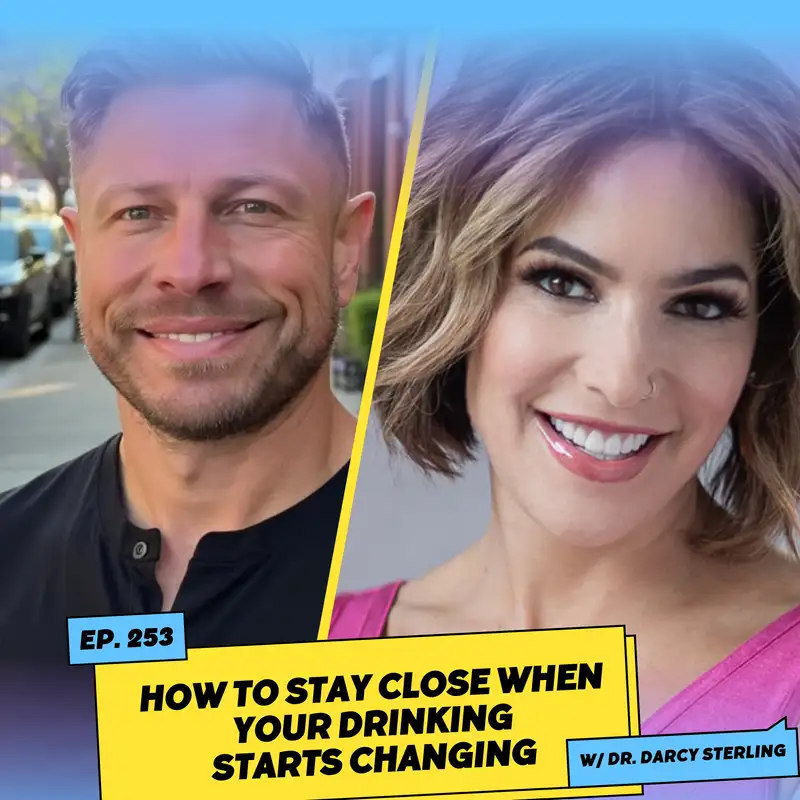
How to Stay Close When Your Drinking Starts Changing w/ Dr. Darcy Sterling
In this episode, I'm joined by Doctor. Darcy Sterling, relationship expert, licensed clinical social worker, and host of We Need to Talk. We talk about what happens when one person in a relationship starts drinking less, especially when alcohol has become part of how a couple connects. For many couples, drinking is woven into date night, vacations, and reconnecting at the end of the day. So when one person starts wanting less of it, the other partner may feel judged, confused, or afraid the relationship is changing.
Speaker 1:Doctor. Darcy explains why alcohol can sometimes become like a third person in the relationship, how to bring up drinking less without creating defensiveness, why support can turn into policing, and how couples can build new ways to stay close. This is a practical conversation about communication, resentment, support, and what it looks like to grow without leaving your partner behind. Okay, Darcy. Thanks for coming on today.
Speaker 2:My pleasure. Thanks for having me.
Speaker 1:Yeah. I'm excited to jump in on some of the dynamics between couples as it relates to alcohol, and we're gonna get into that. But for people who don't know you, how do you describe your work that you do with couples?
Speaker 2:I am a relationship therapist who actually doesn't work with couples. I teach individuals relationship skills, and I teach them how to identify the patterns that get in the way of their relationships and how to run interference on those patterns so that they can create the lives that they wanna create.
Speaker 1:I love that, and thank you for clarifying that. Do you find that there is are these both things that people have to do do should they do things as a couple and as an individual in order to kind of make the relationship work better, or is it do you find that your approach tends to be it starts from the self and then that you bring that to the relationship?
Speaker 2:Well, it's interesting that you asked that because I'm married to a couples therapist. Okay. And there aren't too many people who do what I do. It sounds like I'm a couples therapist, but I'm not. I only work with one person at a time.
Speaker 2:But what I find is that it really only takes one person to monumentally change the dynamic of a relationship because what's happening in a couple is that you're both cocreating these dynamics that exist. And if one of you just changes, even if just 10%, oftentimes, the whole dynamic changes in a positive way. And we've all experienced that. Those of us who are in relationships have experienced that. Like, when one of us is under stress, it absolutely impacts the couple, both of us.
Speaker 2:So if that happens in a negative way, logically, it has to happen in a positive way also.
Speaker 1:Yeah. Totally makes sense. Can you give one example without naming names where somebody started changing and growing and the relationship had to adjust.
Speaker 2:Of course. But can I just go back to what you also asked me? Because it was a really good question. Nobody's ever
Speaker 1:asked Go back to it.
Speaker 2:Nobody ever asked me that before. Should a couple engage with someone like me individually as well as then going into couples counseling? My answer is it depends. If the person so let's just take one partner at a time. If the person has done a lot of their own work, it may not be necessary.
Speaker 2:If they know themselves well, but they just can't run interference on their patterns, couples counseling can can be really effective. Where couples counseling is helped and supplemented by someone like me is when one member of the couple or both members have not done a lot of their own individual work, and they kinda wanna clean out some of the pipes not in front of their partner because it does contaminate the relationship. What you talk about in couples counseling, your partner is hearing. So maybe you just wanna work on some of your own stuff first privately and then go into couples. But I'll tell you, my wife, Steph, and I, we share a private practice.
Speaker 2:And oftentimes, I'll see one of my clients will be coming to me individually, and I will then refer them as their couple to staff because they're only able to clean their side of the street. What's manifesting are opportunities for the couple themselves to grow, and you need a couple's therapist for that to happen.
Speaker 1:Yeah. For sure. I mean, as you're saying it, the thoughts in my mind were, as a couple, you can learn to communicate together, together, and you can communicate your goals. But if you're not actually going out and doing that work on your own, then you're only doing one part of that puzzle. And on the other side of it is you could be doing all the work you can, but if you're not very good at communicating where you're trying to do or where you're trying to go, what you're trying to do, and how that relates to the other person, that only can go so far as well.
Speaker 2:And, also, insight is only gonna get you so far. Most of my clients come to me, and they know exactly what their problems are. I don't disagree with them. They come in. We do a real in-depth assessment.
Speaker 2:And at the end of it, I'm in complete agreement with them about what the problem is. Knowing the problem is about a third of the solution. You've got two thirds still to come. And for that to happen, you need someone who can identify the patterns, show you how to run interference on those patterns, and then hold you accountable for doing that in your day to day work week after week after week.
Speaker 1:What's something that you see every day that comes in and it's like, yeah, it's just a pattern that just reemerges that, with the people that you work with.
Speaker 2:One person, my client, will come to me. I tend to attract people who over function. I tend to attract type a individuals, very hardworking people. And they'll come to me and they'll say, you know, I'm using all the relationship skills in the relationship. I'm doing all the things and cleaned up my side of the street, but my partner is not necessarily meeting me.
Speaker 2:Sometimes what can happen is one member of a couple can over function. And instead of it provoking the partner to rise and meet them at the level that they're at, it'll actually create a dynamic where the partner is, like, able to chill even a little bit more and not have to work so hard because my client is really good at making it look like the whole relationship functions. So in a more concrete sense, oftentimes what happens is a client will come to me, and they will have a way of responding to their partner in conflict or in disagreements that is counterproductive for their partner. So if you're somebody whose response style to disagreement tends to be, I wanna talk about it right now, we call that the fight response. You're not literally fighting today.
Speaker 2:But of the three response style, fight, flight, or freeze, when you tend to need to use your words right away and you have an impulse to resolve things right away, it's generally the the the the the category that you fall underneath is that it's the fight style. It's very rare that somebody who has a fight style is in a relationship with another person who wants to have a conversation immediately. More often than not, they wind up in a relationship with someone who either retreats, does not wanna have the disagreement because of their own history, or looks like they're freezing during a disagreement or a serious conversation and is quite activated underneath that stoic exterior. But the way they present to their client, to their partner is as if they're, like, checked out. Like, they don't even care.
Speaker 2:They look dismissive and, like, they don't like, they're not having any response to their partner. So my client with the who has a tendency to want to resolve things right away has to learn how to dial that it's a strength. How to dial that strength down, creating the space so that their partner who has a different response style, their nervous system can settle enough, and they can come in towards them.
Speaker 1:So I think that this will lead really well into some other things I wanna talk about. But before we move into that, can you kind of just high level describe what those three styles are? So you already kinda explained the one, or maybe how the dynamic works with one another.
Speaker 2:So there is fight, flight, or freeze. We don't literally look like that in today's era. The fight style is someone, as I said, who tends to want to talk about things and resolve things right away. They're problem solvers. They're great with their words.
Speaker 2:They can think on their toe toes. Somebody who engages in the flight response style tends to look for exits. They tend to be unavailable. Either they're checked out because they're self soothing with substances or they're self soothing with overworking or they've got passion projects that keep them out of the house. There are reasons why they're not available or they have other other obligations outside of the house.
Speaker 2:So that's the freeze response. The or did I no. That's the flight response. The freeze response is somebody who they're not going to avoid a difficult conversation. They're going to engage.
Speaker 2:They look and are somewhat passive. They'll meet you when you need to have a conversation, but they're not quick on their feet, and they're not responding to you. And it almost looks like lights are on. Nobody's home. And what that does to the partner who is somebody, you know, more often than not is somebody who engages in conflict resolution in a faster way is it it makes them think that they're just not even there.
Speaker 2:So the partner who is more verbal escalates, and that causes the partner who's somewhat stoic looking and has the freeze response style to look like they're just more and more and more disengaged, and the combination of that fuels a vicious cycle.
Speaker 1:I can I can see how the fight and the freeze, because of my own experience in the past, could just be maddening for the for the fight group because it's like an inaction coupled with a person that really wants to take action? And neither of them are wrong or right or whatever, but, you know, I can see the I can see the how the contrast could be challenging.
Speaker 2:So did you just say that you tend to engage in the freeze response? You look like you engage in the freeze response?
Speaker 1:I'm more the I'm sort of a mix, I think, but I think I'm more the the the fight response, like, re resolve. But when I'm my parents would would be a good example of somebody that would be the freeze personality where they are very much they'll listen, but there's just really no action going on. And, you know, we're we're going through some family things right now, and so I'm I'm kind of, like, going through that. Obviously, it's not a couple, but it's still interpersonal relationships.
Speaker 2:A 100%. And there's still a relationship dynamic that you guys are co creating. So what I would say to you is you have to dial down the problem solving, which is also associated quite often with being male. You have to dial down. You have to slow your cadence.
Speaker 2:You have to dial down the problem solving, and you have to approach them in a way that is more likely to settle their nervous system, like asking them, hey. I'd like to talk about whatever it is you guys are going through. Is now a good time? And if it's not, when would be a good time? So they at least get to consent to when they're gonna have the conversation with you.
Speaker 2:And then, you know, as you go into it, I would when you're dealing with somebody who's got a if you're a fighter, you're dealing with someone with the other two response styles, you wanna go in. You want to try and set their nervous system so that they're not bracing for it because everybody is bracing for it. That's why I named my podcast we need to talk because it just intuitively brings up, oh, serious relationship conversations. No one likes to hear that term. So you can begin the conversation by saying, hey.
Speaker 2:I just want you to know that by the end of this, I'm hopeful that you understand me better, but I'm also hopeful that I understand you better and that we feel closer at the end of this or that we both feel like our needs were met by the end of this. And that is a a good way to soothe the state of the person who is not quick on their feet with words.
Speaker 1:I like that because I can see how it it disarms, you know, in a way that so that you can then communicate. So I wanna actually move us into a little bit more of the odd topic on hand as it relates to alcohol and relationships. And before we get into all the tension or some of the things that might be challenges, Let's just talk about there are some benefits to, the social connection. You know, when somebody it becomes woven a little bit into a couple's re like, their rhythm. Maybe that's what they used to unwind.
Speaker 1:Maybe that's let's go get a drink for date night. Before we get into the tension, what is that doing emotionally with the relationship?
Speaker 2:It's a social lubricant. It is allowing the couple to do things and transition throughout the day, throughout emotional states, and throughout the season in ways that allow them to bypass the emotional work that they would otherwise have to do. And so there's nothing wrong with drinking. If you can do it in moderation and it's not impacting your relationships or your ability to to meet your goals and be the person that you want to be. But there is so much research that speaks to the fact that when people start drinking, you know, and most of us start as teenagers, there is there are there are difficult developmental tasks that we learn to bypass by engaging in the social lubricant of alcohol?
Speaker 1:Absolutely. Well, I think one of the challenges is that when people decide that they want to maybe make a change, I think some are very open, and they voice it immediately with their with their, significant other. Maybe they think this is something that I wanna try on my own. I don't want them to feel like maybe I'm judging them or to be judged myself. When somebody's thinking about making that change that's in a relationship where it is woven into their rhythm, do you have any advice on, like, how they should think about just at the very beginning of it as far as openness and, you know, all of that?
Speaker 2:It's the person who has decided that they want to either minimize, reduce the amount of alcohol that they're that they're drinking or try and experiment with quitting, people don't come to that moment lightly. Right? Like, that is not something that people come to because they just decide, hey, gee, this would be great for my health. They tend to come to that moment because they have a myriad of experiences behind them that have resulted in consequences. Now whether the consequences are enormous or mild or somewhere in between, the bottom line is the vast majority of people who come to that moment came to it because there's something about drinking that doesn't make them feel good anymore.
Speaker 2:Even if it's just the consequence afterwards. Maybe it's how they feel afterwards. You know? Maybe it's the hangover that they didn't used to get that they suddenly get that makes it really hard to engage in the things that are important for them. So starting with just the raw truth of it, I would guide a client to say to their partner, I am considering cutting back and or experimenting with not drinking anymore because I don't love the way I feel when I do it.
Speaker 2:And what I would like is for us to have a conversation about, a, how you feel about that, and, b, how you imagine that's gonna impact our relationship. That transparent and that simple. What do you think about that?
Speaker 1:Yeah.
Speaker 2:Think a real question I'm asking. Like, what do you think about that being the approach?
Speaker 1:I think that that is good because you're talking about something that's personal to you with no reflection on them and what they're doing and telling them, this is what I'm thinking about and ask putting it on them to think to tell you what their opinion is as well without pushing it on them. This is what I've decided, and this is what we're gonna do. And if you're not with me, you know, it it's the opposite. It invites the conversation.
Speaker 2:Right. You're so much more likely to get an open response and a loving response from your partner if you don't villainize the partner for drinking, if you don't begin the conversation by presenting a pile of evidence about how negative drinking has been to both of you. You always speak in I statements. You always speak from your own perspective. You take your own inventory, not your not your partner's inventory, and you create the space so that your partner can lean in then with curiosity as opposed to defensiveness or protecting themselves or, you know, nobody wants to be attacked in a moment like that, and you want support from your partner.
Speaker 1:I like what you said there that people should remember speaking I statements. It's kinda funny because usually we're always trying to make it about the other person to be able to connect with them, but in this case, it's the opposite because then you're not pushing it on them.
Speaker 2:Well, communication skills, you'd be hard pressed to find any expert who guides you to speak about the other person when they're teaching you communication skills. It's always best to take your own inventory and speak in I statements. Makes it so much easier for the other person to hear your feelings without feeling like you're judging them or, like, without feeling like you're about to tell them there's something wrong with them.
Speaker 1:Yeah. That makes total sense. So I wanna ask, let's just assume two scenarios. We'll talk in hypotheticals a little bit. Like, somebody went, maybe they communicated the way you did the way you suggested.
Speaker 1:Maybe they did meet with some openness, and they went forward. Or maybe they didn't maybe approach it so well. But whatever it is, it now is a source of tension in the relationship. Do you think that the alcohol is the real issue, or do you think that maybe there's something else going under going on underneath that that needs to be addressed in order to continue to grow together?
Speaker 2:Is the scenario that you're outlining that one partner told the other partner that they don't wanna drink, and now there's tension between the two of them?
Speaker 1:That's right. The other one is unwilling. Maybe they said go ahead. Maybe they just said, I'm not doing that. You know?
Speaker 1:But either way, now all of a sudden, one is taking steps to drink less. The other one is not on board in in in some way. Now it's causing tension in the relationship.
Speaker 2:It's very easy to get distracted and as the partner who's not drinking and feel as if your partner who is still drinking is unsupportive, is sabotaging, is judging you. It is very easy to land on those conclusions. But what I would encourage and invite people to imagine is that when you remove something like alcohol from a relationship, you're not just removing a drink or a social lubricant. You are removing the segue into so many of the daily, weekly, and seasonal activities that make the couple feel like a couple. The end of the day ritual where we have a glass of wine together, that is the boundary between work and now us.
Speaker 2:Now it's our time. We're on. We're no longer thinking about what happened during the day. Now it's our time, and it's marked by a glass of wine. At the end of the night, maybe there's a nightcap.
Speaker 2:When we flirt, maybe it's easier to flirt with a couple of drinks in us or a few drinks in us. We mourn through alcohol in our society. We celebrate through alcohol in our society. We destress. We engage in all the activities through alcohol.
Speaker 2:So when you remove the alcohol, you've removed some social fabric between each other. And what your partner is generally responding to when you notice the tension is the fear that we have lost the thing that makes us a couple. We have lost the ingredient that makes us young and spontaneous and fun and exciting. It's a fear of losing the relationship. It's not necessarily a fear or a judgment around the partner no longer drinking.
Speaker 2:It's the floor has left. The person doesn't necessarily know how to engage with the sober partner or the partner who is drinking much less. And if you can view it through that lens, you're so much more likely to want to reach for the partner instead of curling inward because you feel abandoned from this person who's not responding the way you want. And here is where communication is everything. Both partners, someone's gotta name the tension.
Speaker 2:Someone has to name the tension. And here's the thing. What nobody is saying is that the fear is that the alcohol has become the third participant in the relationship, and nobody is naming that. That is the real underlying fear. If either partner can lean into that scary conversation and initiate it, what they invite in that moment is the opportunity to learn how to connect without the aid of alcohol and to talk about the fears, again, without the aid of alcohol.
Speaker 2:I mean, how many deep conversations are fueled with alcohol? How many dysfunctional conversations are fueled with alcohol? How many serious conversations that we all need to be having get avoided? Because we've had a few drinks and we're having fun and nobody wants to kill the buzz. It's so it's such an amazing opportunity when something fundamental like drink is removed from the equation to find a deeper way to connect with each other.
Speaker 2:And if one of you can take the risk of naming the the elephant in the room, which is I've noticed there's tension between us since I stopped drinking. I really wanna talk about it. Less about the alcohol and more about the fear that I don't wanna lose you. I don't wanna lose you, and I'm afraid of what this means for our relationship. If you can do that, you can pave a whole new chapter in your relationship that avoiding that conversation will totally rob you of.
Speaker 1:So well put. I think so many people, they want that closeness, but now they've removed something that made it easier for that to happen. And some of some of us will just go on our way and try and do things and remove it, and, obviously, tension will rise. Some people might start saying, instead of us having a drink, come out for a walk with me, you know, in the evening or whatever. But one of the challenges, I think, is that people will give up because they'll invite for a few times that other partner isn't really into doing that yet maybe.
Speaker 1:But but I would love that you brought this up because I think that in those cases, that's happening because that conversation that you've just mentioned hasn't been had yet. How do people approach that conversation?
Speaker 2:I think you have to do it in a transparent way, and I think you have to throw some skin in the game. We're so boundaried and armored up in society, even in our most intimate relationships. You have to just engage in the v word and be vulnerable. You have to just be willing to feel the pain that your partner is not gonna respond the way you want them to respond. Think about it.
Speaker 2:If you're losing something essential in the relationship, and this happens so often, you'll see I'll see individuals who are, like, on the brink of breakup, but they don't wanna have the hard conversation. And I will say to them, you're contemplating ending the relationship. What could be more dismal than that? You got nothing to lose. You got nothing to lose.
Speaker 2:Throw some skin in the game and say the scary thing. And that way, you'll know that you did everything you could. So you just have to tell the partner, ever since you stopped drinking, I don't know how to reach you. I don't know if I'm supposed to drink at home or not. When I drink, I feel so uncomfortable.
Speaker 2:I don't know if I'm triggering you. I don't know what the rules are. You said it's okay for me to drink. It's not even that much about the alcohol. It's about you and me.
Speaker 2:I don't know how to reach you. I'm looking for you, and I don't know how to find you right now. Can we figure out a way how to get through this together? Because I don't if you don't like the way alcohol makes you feel, I don't want you drinking. I wanna support you, but I don't wanna lose us in the process of that.
Speaker 2:That's what I would recommend.
Speaker 1:Yeah. Yeah. Yeah. No. That's great.
Speaker 1:I love it. I love it. Know, let's let's turn it a little bit different before we we start to wrap up. But one thing I wanna say is, let's say let's do another hypothetical where they both sort of decided, hey. This is what we're gonna do.
Speaker 1:Let's do it together. How can a couple support each other in a in a way that's constructive versus policing one another or something like that? Like, you know, what's what's a good approach to that where they're both on board?
Speaker 2:So the temptation when both of you wanna start a new habit is to do it in the exact same way. You know, we just talked about all the different response styles. We all have different histories from our partner. We have different life experiences. We have different personality types.
Speaker 2:We have different personality tendencies. What works for me is not gonna work. Let me just tell you. My wife and I recently both basically stopped drinking. Not that recently.
Speaker 2:It's been like I don't know. For her, it's been like two years. For me, it's been like a year and a half. It wasn't mindful for me. It was for her.
Speaker 2:So we'll use us as an example, and I haven't gotten consent, but she doesn't care. Mhmm. I'll get it before I'll I'll get it so that you know that you have it. Okay? Because that's the right way to do it.
Speaker 2:So we were in a car accident, and it was a bad one. The car was totaled. She was the driver. She was more injured than I was. Doctors wanted to throw all kinds of drugs at her.
Speaker 2:We were like, hard no on those drugs. No. But they did give her, you know, a a nerve relaxer, something for, like, nerve damage. And even though the research says there's no addictive quality, I'm sorry. We've lived through the whole oxy thing.
Speaker 2:We've been in practice. I've been in practice thirty years. She's been in practice twenty years. We had a conversation. We were like, there is no alcohol happening while you're on this drug.
Speaker 2:No alcohol happening. That was, like, two and a half years ago. She never looked back. Now we're New Yorkers. We were hard drinkers.
Speaker 2:We were big drinkers. And at first, you know, because I have a lot of addiction training, and my addiction training back then was less around harm reduction and more around abstinence only. I was like, well, I'm not drinking in front of her. I am not drinking in front of her. That's probably how it started.
Speaker 2:I stopped drinking in front of her. And then something strange happened to me, but she started using your app. She used your app. And if I had done if I had done it, well, I probably would have used a spreadsheet first and then gone to the app. The point of the matter is is that we both did it in our own unique ways.
Speaker 2:She did it in her way. I did it in my way. I will still have a couple of drinks a week, but I don't have an addictive bone in my body. I'm very, very lucky. Only thing I'm addicted to, my friend, is work.
Speaker 2:That is it. You know? And, yeah, that that creates its own problems. But we couldn't do it the exact same way. And if you try to do it the same way with your partner, one of you will become the sober police.
Speaker 2:That is so not sexy. That is so unattractive. That like, the arousal will go down so quickly if you try to do that. You have to have a conversation and say, okay. So I'm curious how you wanna do it, and I guess I'll give some thought to how I wanna do it.
Speaker 2:And then we'll both ask each other how we can support each other, but you can't impose rules on each other. Because the minute you start doing that, you become the sober coach. And that is It's not good for relationships. You worry about you. You worry about how many drinks you're having a day, you're having a week, you're having a month, you're having a year.
Speaker 2:Do not worry about your partner. Check-in with your partner and ask your partner, how's it going? How is how I'm managing this working for you? Having a drink a week in the house, two drinks a day in the house. How is that for you?
Speaker 2:Is that too much? And get feedback, but be prepared that if you ask the question, you're gonna hear the answer. That doesn't mean that that's a directive to change your behavior. But what it does mean is that you hold space for your partner, and you don't debate whether their perspective is right or wrong. And then hopefully, your partner does the same for you.
Speaker 2:But since I only speak to one person at a time, I can never promise my partner that what they extend to their partner is gonna come back to them because I only work with the one person. So the best of my advice is to be as generous as possible to your partner and also check-in consistently. How's it going? What do you wanna do differently? And then if you're both doing it at the same time, that's pretty amazing because then you have two people who are more likely open to new rituals and new activities.
Speaker 2:When you begin to get sober and you see how much of your life revolves around alcohol, even if you're just a moderate drinker, you go out for plans, you don't do anything. Do you do you like like the wearables, the rings, the Oura Ring, the Apple Watch, all the things that track our steps, You go out on a Saturday night. You're lucky if you log 200 steps because you're eating and drinking. If you stop drinking, watch how other health measurements change. And look at think about all the activities that open that open up for you.
Speaker 2:We just don't even think creatively about what we wanna do on a date. We don't even think creatively about what we wanna do for entertainment. We eat and we drink. It's it's quite boring when you really drill down on it.
Speaker 1:Yeah. It really is. You start to change your perspective. Well, first, thanks for sharing your personal story. I appreciate that, all the openness.
Speaker 1:And it it does sort of, like, make me think, to ask one more question in that regard. And so you guys went through that journey, and it does give you opportunity to have different experiences connect in new ways. Is there one way that you remember and especially, like, New Yorkers, you guys were probably always out thinking there's there's positives. Like, oh, I loved that restaurant, or I loved to get in a little wild at that place or this place. But is there on the on the new path that you guys are on, is there one instance that you can think of where this probably wouldn't have happened had we not made this this right turn?
Speaker 2:Oh my gosh. Yes. I had never hiked before in my life. I did not understand that hiking was just walking in nature. It seemed to me like it was going to be such a heavy lift and, like, there were I don't know what I don't remember what I thought was involved in it, but my entire adult life and young adult life, I have been invited to engage in this thing called hiking, and I have been a hard no to it constantly.
Speaker 2:And everyone around me loves to hike. I had never done it until a couple of years ago. Now it's one of my favorite things in the world to do because it's not exhausting. It's actually quite beautiful. You get to be outside.
Speaker 2:You get to smell nature. I was I thought there were bugs involved and snakes involved, and I'm a girl's girl. And I just, like, you know, I just didn't I don't like being dirty. I don't like you know, I don't want mosquito bites all over me. I'm I'm a little bit of a baby like that, but hiking is one of my favorite things to do now.
Speaker 2:I forgot how much I love nature. I forgot as a kid how much time I spent in the woods before I decided I was afraid of bugs. And I just love going on a hike. I love walking. I like moving.
Speaker 2:We're too sedentary in life, most of us. And I certainly am as a therapist. I'm sitting almost all day long unless I'm in a standing session. Any opportunity to walk, I'm down. So hiking, walking in nature, you wanna do that with me?
Speaker 2:I'm happy to do that with you.
Speaker 1:I'm right I'm right there with you. You know, what's so funny is I can I'll throw a little same story is that I went back to my alma mater. I went to University of Arizona. Obviously, I was party guy in college. I went there now.
Speaker 1:I got up. I went hiking in the canyons in the morning early in the morning. I'm like, I didn't even know any of this existed or any of this was here when I was, you know, there for college. And now experiencing it in a whole different way, I I wish I could rewind the clock and change sort of how I was. Maybe not all the way, but part of the way.
Speaker 1:And, yeah, there's nothing like getting out there and going for a hike, and nothing validates living in a healthier way than than those moments.
Speaker 2:I love it. I literally love hiking. I can't believe I can say that, but I do. Dirty.
Speaker 1:It's wonderful. Alright. I got one more question for you. So anybody that's maybe navigating this at at different stages of what we just talked about, is there maybe one thing that you want them to know or maybe one thing that they could say to themselves to to sort of center and reset themselves, maybe in relation to the partner, maybe in relationship to just how they approach things.
Speaker 2:To reset themselves. Can you just be a little bit more specific?
Speaker 1:Yeah. Well, how about I put this way here? Let me have a little bit of I'm I'm not really going on my questions, but I'll ask you this. Okay. So for anybody that's listening and you know, we talked about different stages within things, but is there one thing that you think people could carry into their week wherever they are in their journey?
Speaker 1:And maybe it's something that they tell themselves, you know, how to approach things and how to talk to themselves. Is there any one piece of advice you'd like anybody listening to know?
Speaker 2:Measure yourself against how you did yesterday or last week or last year as opposed to measuring yourself against an ideal. Because most of us have dreams and soft goals that we don't really quantify and turn into SMART goals, so it's hard for us to measure progress. And the result of that is often that we feel bad about ourselves. We use the lack of a real definition around a goal or something we wanna improve to make ourselves feel bad. So when you find yourself doing it, and we all do it, you know, I should've I shouldn't have eaten that for dinner.
Speaker 2:Shouldn't have shouldn't have, hit snooze today. I shouldn't have skipped the workout. You know? I shouldn't have said yes to the party because now I'm gonna be triggered. I'm gonna be around a lot of alcohol.
Speaker 2:Just say to yourself, was it a little bit better this week than last month? Is it a little bit better? Because that little bit better, that is really the greatest indicator of progress. It's not the big one eighties that create the paradigm shifts. It's the small incremental changes that we make on a micro level, whether we realize it or not, that in a cumulative way results in what our life looks like, those little baby habits.
Speaker 2:So if you can be a little bit more generous and compassionate when you hear your that internal judge that we all have say, you shouldn't have done this or you should have done that, Just ask yourself, is it a little bit better this week than it was last week or last year? And if the answer is yes, and it usually is, then give yourself some grace and just make another small decision like that tomorrow.
Speaker 1:Yes. That's it right there. What a great piece of advice for anybody. Yeah. Those big wins don't just come overnight.
Speaker 1:And so first of all, I wanna say thank you so much for doing this. But before we go, if anybody's listening or you have some new projects that you have coming up, I'd love for you to talk and share and how people could learn more and reach out to you.
Speaker 2:Well, I have a podcast called we need to talk with doctor Darcy Sterling, and you can listen to it wherever you listen to your podcasts or watch it on YouTube. And it's a dating and relationship podcast. So I like to drill down on the nuanced answers to everyday questions that most of us avoid. That's what I like to do.
Speaker 1:Yeah. That's great. So if anybody's listening, make sure to go check that out. Darcy, thanks so much for coming on today. I really enjoyed our conversation, and thank you for sharing.
Speaker 2:My pleasure. Thanks for having me.
Creators and Guests