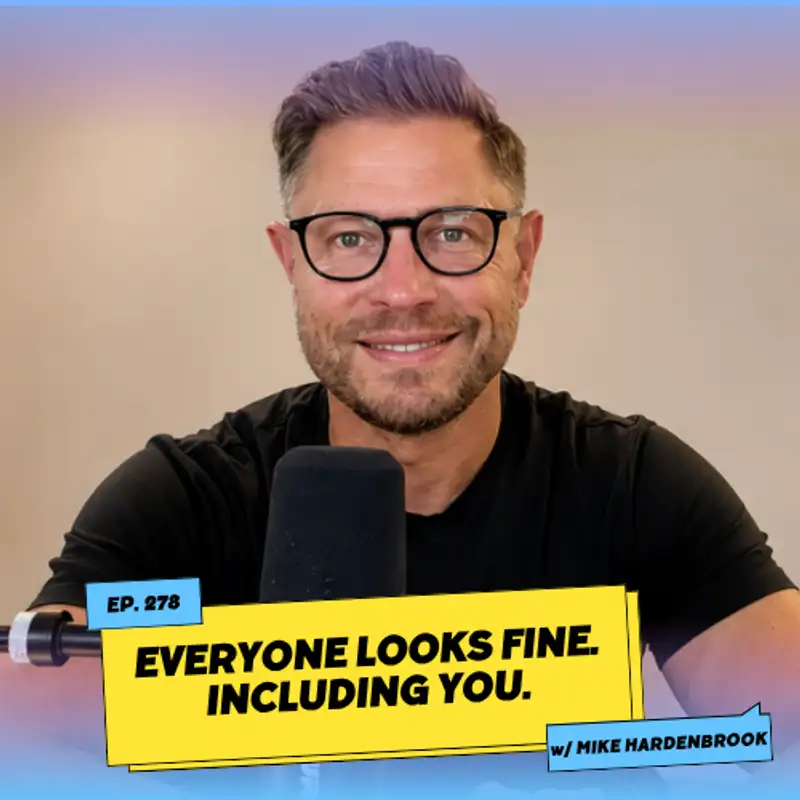
Everyone Looks Fine. Including You.
Hey, everybody. Welcome back to another one of these ten minute Mondays. Today, I wanna start off with taking you back to a story. At Thanksgiving, actually, several years ago when I lived in Scottsdale, Arizona, we were at this huge, beautiful home in one of the most prestigious areas overlooking Scottsdale. It was the kind of place where the setting alone made that gathering feel special.
Speaker 1:It had the house, the view, the people. Everything about it looked like success. The people seemed to match the setting. Men and women from all kinds of industries. We had business owners and executives and professionals, people who built really impressive careers and also had families.
Speaker 1:There was always this bottomless full bar. Wine was available. In fact, every year, they'd buy one of those giant wine bottles that are, like, you know, five times the size of a regular wine bottle. The refrigerator was stocked with beer, and you really didn't have to wait for a drink to come. You could just walk up.
Speaker 1:You'd grab whatever you wanted and then go back to the conversation. And throughout the gathering, that's what people did. Nobody was acting out of control. Nobody was creating, like, this big scene. This was around the time that I was trying to make a change in my drinking, and I was doing it all on my own.
Speaker 1:And I remember looking around the room, and I was just doing quiet calculation in my head, which was everyone here is drinking. But then also, hey, look, these people are doing really well in life. They seem happy. Their families seem happy. And some of them are much older than I am.
Speaker 1:So in my mind, they've probably been doing this for years, probably decades, without it being a real issue. The thing is that age gap, that mattered to me. I wasn't really looking at a group of, let's say, 25 year olds who had only been living this way for a few years. I was actually looking at people with decades of adult life behind them. And I treated their careers, their homes, their families pretty much as this proof that drinking this way had already been tested over time with them.
Speaker 1:And that thought gave me relief. It gave me validation. Because if all these responsible people, they drink and some of them drink more than I did, then maybe I didn't really need to think too hard about my own drinking. Maybe this was more like how people live and everything else was fine. Now this wasn't the first time that I had this argument in my head.
Speaker 1:I had reached other versions of it before whenever my own drinking started to kind of bother me. But the room gave me this fresh supply of evidence. Evidence that for that night, I didn't need to sit with whether my relationship with alcohol felt alright to me. I had to only look around the room, and I found the answer that I wanted. But years later, I realized something about that Thanksgiving that I couldn't see at the time.
Speaker 1:I really had no idea what any of those people thought about their drinking when they were alone. Maybe they were completely happy with it. Maybe some of them had never really even questioned any of it. But maybe someone in that room had recently tried to cut back. Maybe somebody was planning on taking January off.
Speaker 1:Maybe somebody was wondering why alcohol had started to affect their sleep, their health, how they felt and their mood, and maybe why it had become harder to stop after the first few drinks. The thing is, I really had no way to know. And at the same time, they had no way to know what I thought about mine. That doesn't mean that everyone at that Thanksgiving was secretly struggling. I don't believe that.
Speaker 1:But there could have been somebody in that room looking at me making the exact same calculations that I was. Hey. Mike's got a family. He's got a business. He takes care of himself.
Speaker 1:He seems happy, and he's drinking. And that raises a question. What if some of the people that I was using as proof were also using me as proof? When we think about social pressure around alcohol, we usually imagine somebody saying, come on, have another round. It's only one, or asking why we're not drinking.
Speaker 1:But nobody at that Thanksgiving pressured me to do anything, and nobody needed to. The room itself made drinking look like part of a successful life. Researchers keep finding that people overestimate how much everyone else is drinking and how Okay everyone else is with heavier drinking. Now it's important to note that most of that work has been involved with younger adults, but the mistake, it's easy to recognize at any age. I know I did.
Speaker 1:We confuse what we can see with the whole story. And at that Thanksgiving, I could see someone walk up to the bar and pour another glass of wine. I could see the beer that they took out of the refrigerator. I could see the people laughing and talking and appearing at ease with everything. What I couldn't see was the conversation that they may or may not have been having with themselves.
Speaker 1:And the same was true when they looked at me. From the outside, I probably made a pretty convincing case that drinking fit comfortably inside a good life. Nothing about looking at me across the room would have probably told somebody that I had spent years wondering where alcohol had become a larger part of my life than I really wanted. I wasn't lying to anybody. I wasn't trying to hide some secret identity.
Speaker 1:They just simply couldn't see a private question that I wasn't saying out loud. So if somebody looked at me that night and thought, hey, Mike's doing well, so he must be fine, they were working with incomplete information, just like I was when I looked at them. And that's how a group can manufacture a version of what normal is without anybody even intentionally misleading anyone else. So each of us assumes the other person isn't thinking about it at all. We were each other's proof.
Speaker 1:And sometimes capable people can make especially convincing evidence. Sometimes our lives don't fall apart because we're exceptionally good at pulling them back together. And that was the mistake I made. I treated their visible success as an answer to a private question about my own life. So here's an experiment that I think can help separate what you genuinely want from what the room has taught you to want.
Speaker 1:Ask yourself this. If nobody around me drank, would these same occasions still seem to call for drinks? Think about that Thanksgiving without the stock bar, that beautiful home that was great to be in, that would still be there. So would all the people, the food, the families, and the reasons that we actually gather. Would I have thought about it in the same way if nobody else's glass was available as evidence?
Speaker 1:That's a different question. It removes the room for a moment. It lets you see how much of the choice belongs to you and how much of it comes from instruction that nobody ever had to say out loud. I could still picture that Thanksgiving, the house overlooking Scottsdale, the full bar, the refrigerator stocked with beer, all of those people who seemed happy and at ease. At the time, I thought the room had the answer to my question.
Speaker 1:The thing is I'll never know, and that's the point. We can see someone drinking and the life that they built. We can't see what the drinking feels like from the inside of that person's life. The other people's lives can make a pattern look totally normal, but they can't tell you whether the pattern is right for you. So forget whether your drinking looks normal for a moment and ask yourself one question.
Speaker 1:Would I recommend my exact relationship with alcohol to someone I love? Okay. Thanks for hanging out with me this week. If you got anything out of this podcast, please rate and review wherever you're listening to. Of course, send me an email at mike@sunnyside.co.
Speaker 1:And until next time, cheers to your mindful drinking journey.
Creators and Guests