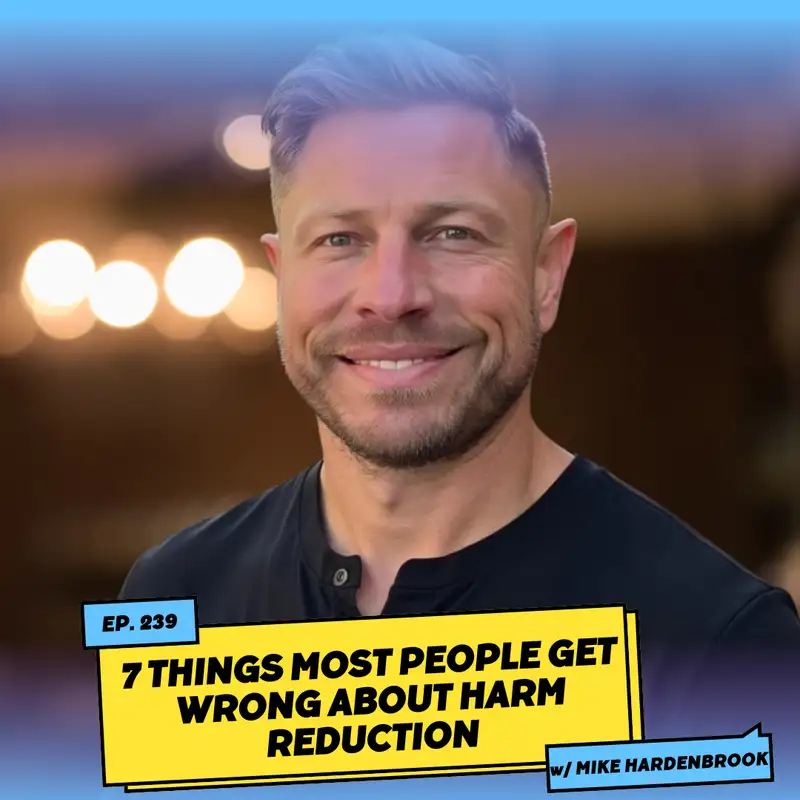
7 Things Most People Get Wrong About Harm Reduction
Welcome back to another one of these ten minute Mondays. I am coming to you from Florida. We've been spending about a week here, and today, I wanna talk about harm reduction, and specifically, why almost everybody gets it wrong as what that is the first time they hear it. Because some people, they think that praise means, oh, they're not really trying or giving themselves an easy out, and if you know harm reduction, you know that's not what it is and not even close. And I've had my friend Andrew Tatarski on the podcast who is an expert on harm reduction, psychotherapy, and a pioneer really.
Speaker 1:And he's been on more than once, and we talk regularly outside of those episodes. And every time that we dig into this, I come away thinking kind of the same thing. Once you actually understand harm reduction, it changes how you think about change itself. So today, I want to give you seven things that most people still get wrong about harm reduction. Okay.
Speaker 1:Number one, harm reduction is not trying less. That's probably the biggest misunderstanding. People hear the phrase and assume it means lowering the standard, like you're not even gonna go for it. But that's not what it means. It means that you stop pretending that change only counts when it's dramatic change or perfect or everything all at once.
Speaker 1:Real change usually happens in steps. Messy ones, slow ones, honest. I mean, think about all these big successful companies. They didn't just get there overnight. They went there step by step, mistake by mistake.
Speaker 1:So taking things by steps is not the same as trying less. And a lot of the time, it's actually the first reason people actually start making progress. Alright. Number two, it does not begin with someone else's goal. This is a big one when it comes to harm reduction.
Speaker 1:A lot of people are used to thinking, the conversation starts with somebody telling me what you need to do. You need to quit. You need to stop this. You need to commit. You need to decide.
Speaker 1:Draw a line in the sand. But Andrew's whole framework and that of harm reduction flips that. It starts with where you are. It's what is true for you right now. What feels realistic?
Speaker 1:What matters to you enough that you're willing to begin there? Well, that doesn't mean anything goes. It means the starting point has to be honest. Because if the starting point isn't honest, everything is built on top of it gets shaky. That foundation is not set.
Speaker 1:Okay. Number three, any positive change counts. This is one of the clearest things that Andrew says and that I take away from our conversations, and I think it's one of the most important, is that any positive change counts. That means less harm matters. One drink less matters.
Speaker 1:A different choice matters. More awareness matters, and a better plan one night matters. And I know for a lot of people that almost sounds too soft, but I actually think that it's the opposite. Because when people believe that only mass change counts, they discount all the smaller changes that are actually building momentum, and those do matter. And then they miss the fact that those smaller changes are often the exact reason bigger changes become possible later.
Speaker 1:Okay. Number four, harm reduction is not the opposite of abstinence. This is where a lot of people get this wrong. They hear harm reduction and think, okay, so it's this anti abstinence camp. That's not it.
Speaker 1:And Andrew is very clear about this. Harm reduction, it's an umbrella. It includes safer use. It includes reduced use, moderation, and it includes abstinence. Abstinence is absolutely part of harm reduction.
Speaker 1:It's just not the only acceptable place to start, and that's the distinction that matters. Because once abstinence becomes the only valid goal from day one, you end up losing a lot of people who might have been open to change, but were really not ready to sign up forever on day one. Okay. Number five, it's not about removing accountability, it's about removing shame. And that is a big difference.
Speaker 1:Some people hear nonjudgmental and assume it means that there are no real standards, no honesty, maybe not even responsibility or self confrontation, and that's not what this is. It means that you stop using shame as the engine. Because as we know, shame usually doesn't make people get more honest or make big changes, because we all shame ourselves and see ourselves in the same pattern. It makes us hide them. It makes us kind of maybe spin in this circle round and round.
Speaker 1:And sometimes it makes people say, well, you know what? I already screwed up, so what's the point? I might as well go all in. A nonjudgmental approach does not make change any weaker. It makes awareness more possible.
Speaker 1:And awareness is what gives you something to work with. Okay. Number six is it's not just a philosophy, it's practical. This is also another thing that people miss. They hear harm reduction and they think it's mostly just about language or attitude, but it gets very practical and very fast.
Speaker 1:What's your plan tonight? What tends to happen after a drink or two? What situations go out of control for you? What would reduce the harm this week or this weekend? What would be a better pace?
Speaker 1:And what would be a more realistic goal? Those things are not abstract. And, of course, this is where planning comes in. This is where tracking helps. And that's where reflection gives you something to work with.
Speaker 1:The whole point is that there is no single right tool. There's just what actually helps you make a better decision from where you are. Alright. Number seven is the old model missed a lot of people. This is one of the most important parts of Andrew's work in harm reduction, is that for a long time, the story was basically this.
Speaker 1:If someone didn't do well, or they weren't ready, or they weren't motivated, they hadn't hit rock bottom, they were too resistant, they weren't open to change. And Andrew in harm reduction pushed back on that. He looked at how few people were actually helped compared to how many were struggling and wanted help. And instead, he asked a different question. What if the problem was not just the person?
Speaker 1:What if the framework itself is missing most of those people? And that's such an important shift when it comes to treatment, because if it moves the conversation away from blame and toward effectiveness, not who failed, but what actually helps. And that, especially to me, is why harm reduction matters. It opens the door wider. It gives people somewhere to begin, and it makes room for the kind of honesty that actually leads somewhere.
Speaker 1:People tend to change better and accept it when they feel met rather than when they feel managed. Okay. So if the first time you're using Sunnyside and you feel like, finally, you have a solution that's meeting you where you are, that's because we designed it that way. We designed it to meet you where you are, for you to choose your goals, and to select the path to get there. Alright.
Speaker 1:Thanks for hanging out with me today. If you got anything out of this episode, please rate and review wherever you're listening to. Always love hearing from you. Send me an email, mike@sunnyside.co. And until next time, cheers to your mindful drinking journey.
Creators and Guests